



 2026-09-22
 76
76 In the competitive world of display technology, anti-glare (AG) cover glass plays a critical role in enhancing readability and user experience across applications such as industrial HMIs, automotive displays, outdoor kiosks, medical equipment, and consumer electronics. Achieving optimal anti-glare performance requires precise measurement and control of key optical parameters: haze value, gloss level, and light diffusion. Understanding these metrics according to established industry standards ensures consistent quality, helps manufacturers meet application-specific requirements, and supports buyers in selecting the right AG cover glass.
AG Anti-Glare Cover Glass Optical Specifications & Testing Methods
How to Choose AG Glass for Interactive Whiteboards and IFPD
Spray Coated AG Glass for Interactive Flat Panel Displays
Three interrelated metrics define AG performance:
l Haze Value quantifies light scattering.
l Gloss Level measures specular (mirror-like) reflection.
l Light Diffusion (often expressed via Distinctness of Image/DOI or clarity) evaluates how evenly light is spread and how sharp transmitted or reflected images remain.
These parameters are inversely related: higher haze and lower gloss generally deliver stronger anti-glare effect but can reduce clarity if not carefully balanced. High-quality chemical-etched AG glass achieves excellent glare reduction while maintaining transmittance above 89–92%.
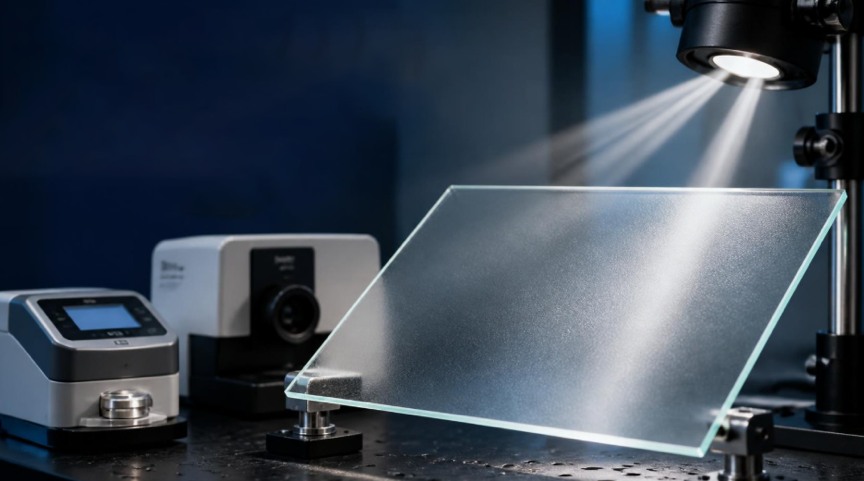
Haze is the percentage of transmitted light that is scattered more than 2.5° from the incident beam direction. Higher haze produces stronger diffusion of reflections.
Measurement uses an integrating-sphere hazemeter. Parallel light from a standard illuminant strikes the sample; the ratio of diffuse transmitted light (Td) to total transmitted light (T2) is calculated as:
Haze (%) = (Td / T2) × 100
Typical AG cover glass ranges:
Light AG: 1.5–5%
Medium AG: 5–12%
Heavy AG: 12–20%+ (or higher for specialized outdoor/privacy applications)
Gloss quantifies the intensity of specular reflection relative to a polished black-glass standard (100 GU). Lower gloss indicates stronger matte/anti-glare performance.
A gloss meter measures at three geometries:
l 60°standard starting angle for most AG surfaces
l 20°recommended when 60° reading >70 GU (high-gloss differentiation)
l 85°recommended when 60° reading <10 GU (low-gloss resolution)
15–45 GU: Strong anti-glare (outdoor kiosks, electronic whiteboards, high-sunlight environments)
40–70 GU: Balanced performance (industrial HMI, medical monitors, ATMs)
70–110 GU: Mild anti-glare with high clarity (consumer electronics, automotive interiors, premium indoor displays)
Light diffusion describes the angular distribution of scattered light. While haze captures the total scattered fraction beyond 2.5°, diffusion metrics assess the quality and uniformity of that scatter, directly influencing perceived anti-glare effectiveness and image sharpness (sparkle/DOI).
l Distinctness of Image (DOI) or Clarity percentage
l Proprietary angular profiles (e.g., AGC-Diffusion using goniophotometers)
l Reflection image diffusiveness and anti-sparkle indices
Gloss (GU @ 60°) | Haze (%) | Transmittance (%) | Typical Application | Anti-Glare Strength |
15–45 | 10–17+ | 86–89 | Outdoor displays, whiteboards | Strong |
40–70 | 5–11 | 88–90 | Industrial HMI, medical, POS | Medium-Strong |
70–95 | 2–6 | 90–91 | Tablets, indoor monitors | Medium |
95–110 | 1.5–3 | 91–92 | Smartphones, automotive, high-res panels | Mild |
l Batch-to-batch consistency
l Compatibility with optical bonding (OCA/OCR)
l Predictable behavior under real lighting (sunlight, factory overheads, medical lamps)
l Reduced sparkle on high-PPI displays
Leading factories measure multiple points per panel and maintain tight tolerances (e.g., ±2–5 GU or ±1% haze) through controlled chemical etching processes.
Precise control of haze value, gloss level, and light diffusion is the foundation of high-performance anti-glare cover glass. If you need custom AG cover glass with verified haze, gloss, and diffusion specifications, contact our engineering team for samples, full optical test reports, and tailored quotations. We support high-volume production with strict process control and rapid prototyping to accelerate your product development.
Haze is typically measured with an integrating-sphere hazemeter that compares total transmitted light with diffusely scattered transmitted light. The exact test method and sample setup should be agreed between buyer and supplier.
Haze describes transmitted-light scattering, while gloss describes mirror-like surface reflection. They are related but measure different optical behaviors, so both are useful in an AG specification.
A 60-degree geometry is a common general comparison condition. High-gloss or very low-gloss surfaces may use 20-degree or 85-degree geometries under the agreed method. Always compare values measured at the same angle.
No. ASTM D1003 is formally a method for haze and luminous transmittance of transparent plastics. It can be used as a commonly referenced haze methodology in some glass projects when buyer and supplier explicitly agree the application and test setup.
There is no universal best value. The target depends on display resolution, lighting, viewing distance, sparkle tolerance and required glare reduction. Approve the value using the actual display whenever possible.
Because haze is only one total scattering metric. Surface gloss, angular diffusion, microstructure and sparkle can differ even when the haze percentage is similar.
Use multiple measurement points such as the center, corners and selected edge locations. Large panels should be checked for haze, gloss and appearance uniformity across the full active area.
Sparkle is a grain-like artifact created by interaction between the AG texture and display pixels. It is especially important for high-resolution and 4K displays and should be evaluated on the real panel.
Yes. Transmittance and haze describe different aspects of optical performance. A useful AG specification normally considers both, together with gloss and application-specific clarity requirements.
Include the glass ID / lot, instrument, test method, measurement geometry, sampling positions, haze, gloss, transmittance, any sparkle / clarity assessment and the acceptance criteria.

Copyright © 2026 Fuxin Glass (Dongguan City) Technology Co., Ltd. All Rights Reserved