


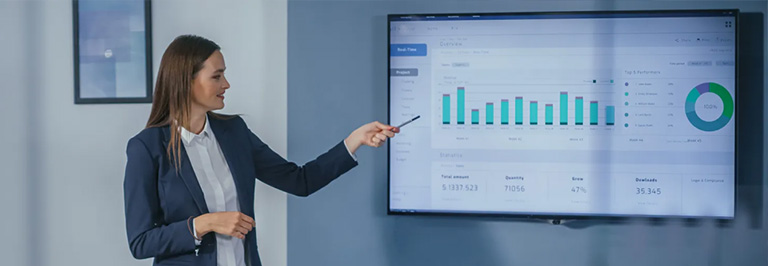
FUXIN provides custom surface treatment for display and touchscreen cover glass, including AG anti-glare, AR anti-reflective, AF anti-fingerprint and AM antimicrobial functions. These treatments solve different problems: AG controls distracting reflections, AR reduces surface reflectance and improves optical transmission, AF improves cleanability and touch feel, and AM is used where antimicrobial surface performance is required.
For OEM projects, surface treatment should be selected together with the glass substrate, thickness, strengthening method, display brightness, touch system, printing, bonding structure and service environment. FUXIN can evaluate single treatments or compatible combinations such as AG+AF, AR+AF and AG+AR+AF, then integrate them with glass cutting, shape processing, strengthening and silkscreen printing from prototype through mass production.
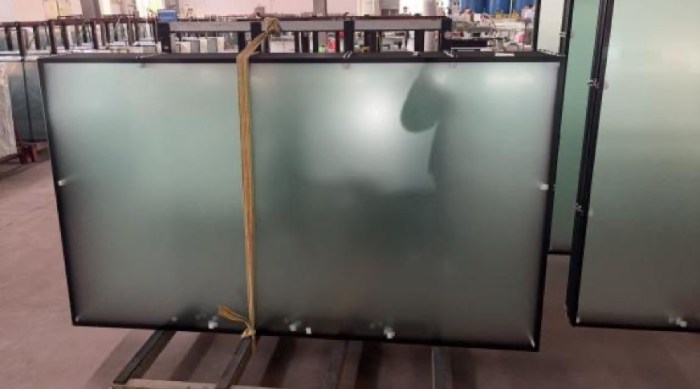
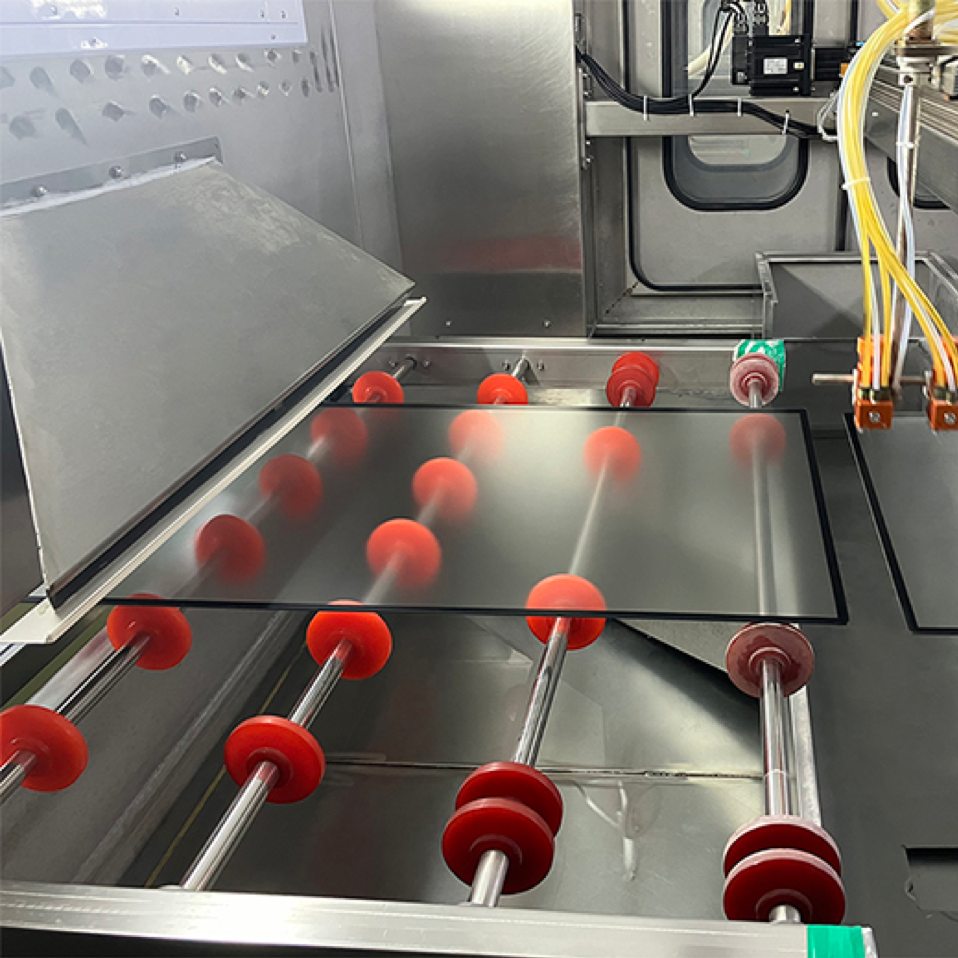
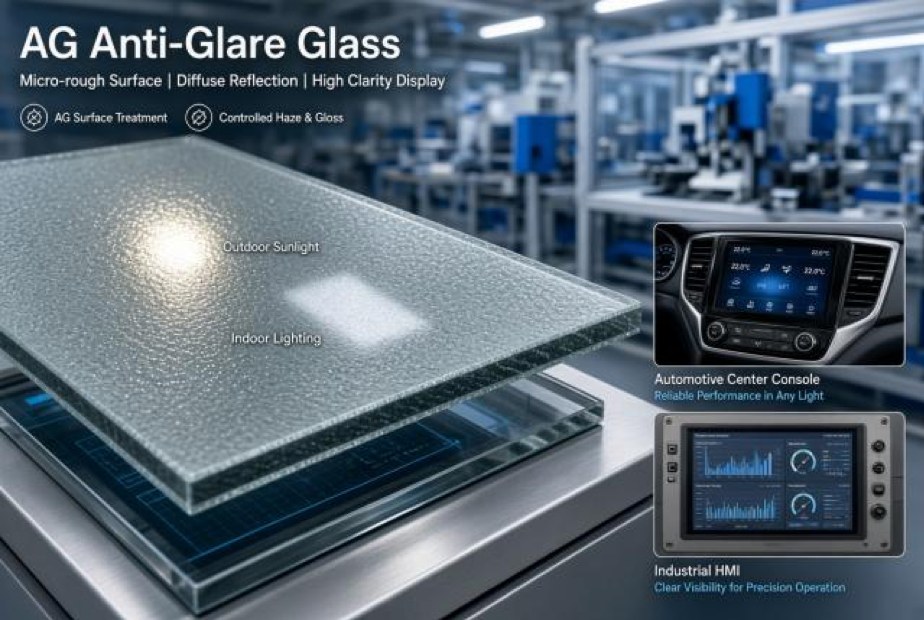
By chemical etching or spraying, a controlled micro-rough structure is formed on the glass surface, converting specular reflection into diffuse reflection and effectively reducing glare under strong light.
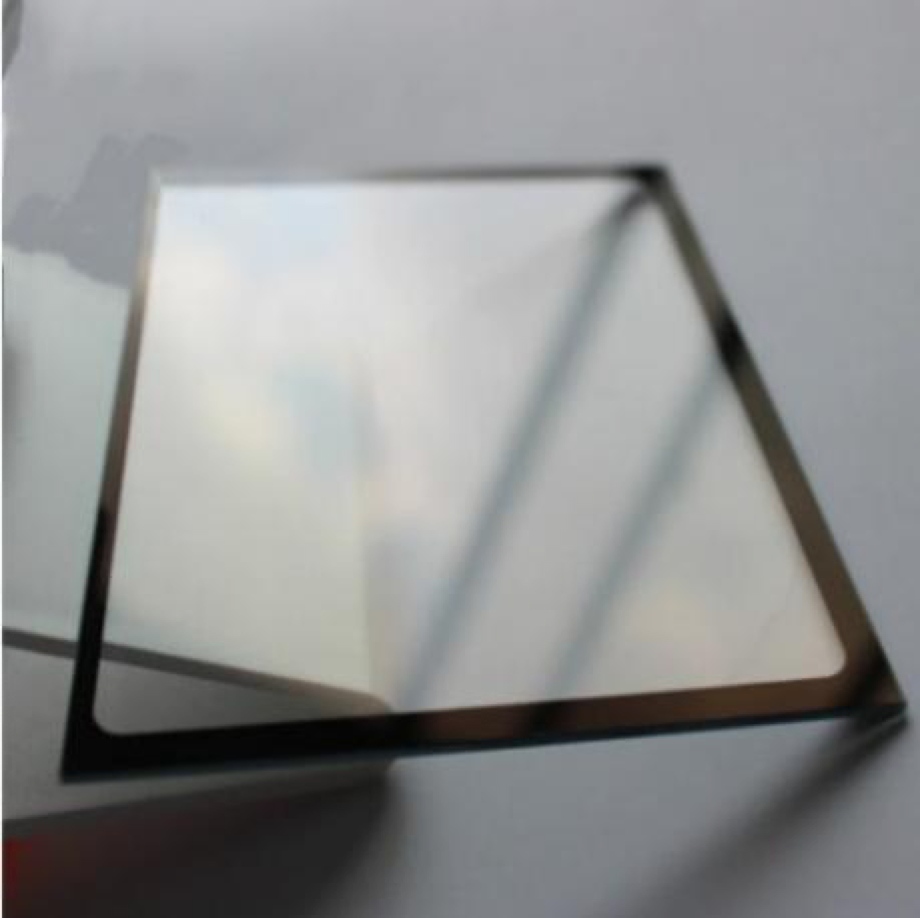
Main Processes: Chemical etching (recommended for mid-to-high-end), spray coating, plasma spraying
Key Controllable Parameters:Gloss 60–150 GU, Haze 10%–30%, Surface roughness Ra 0.05–1.5 μm, Controllable transmittance loss
Advantages: Excellent durability (etching method bonds with the glass substrate),suitable for subsequent chemical strengthening and composite coating.
Typical Applications: Automotive center console / instrument cluster, outdoor advertising screens,ATM/POS terminals, industrial HMI, EV charging stations, medical displays, and other strong-light environments
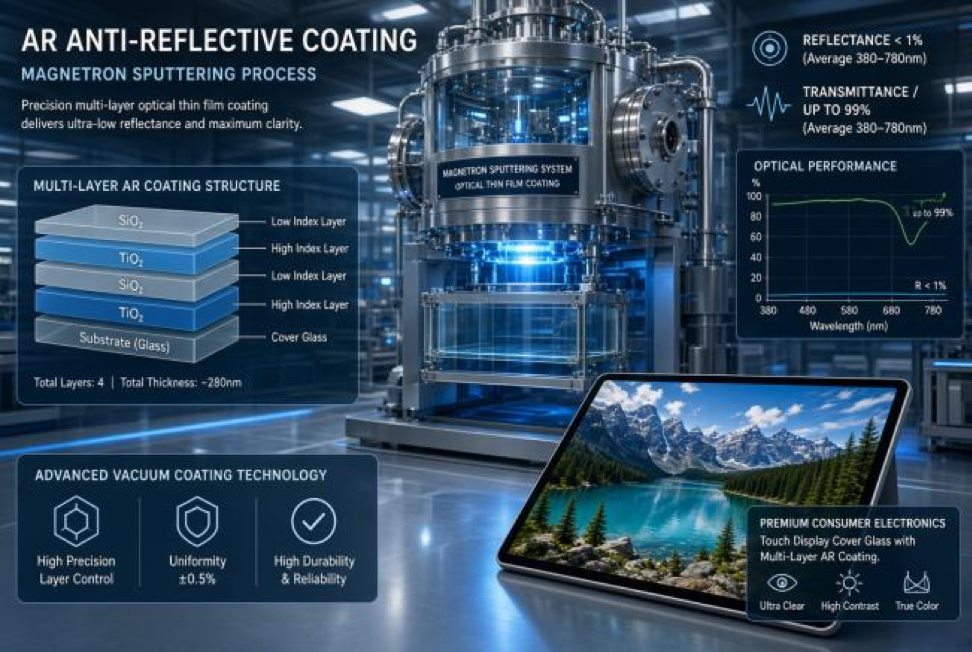
Vacuum coating (magnetron sputtering / evaporation) or multi-layer optical film systems utilize interference principles to significantly reduce surface reflectance and increase transmittance.
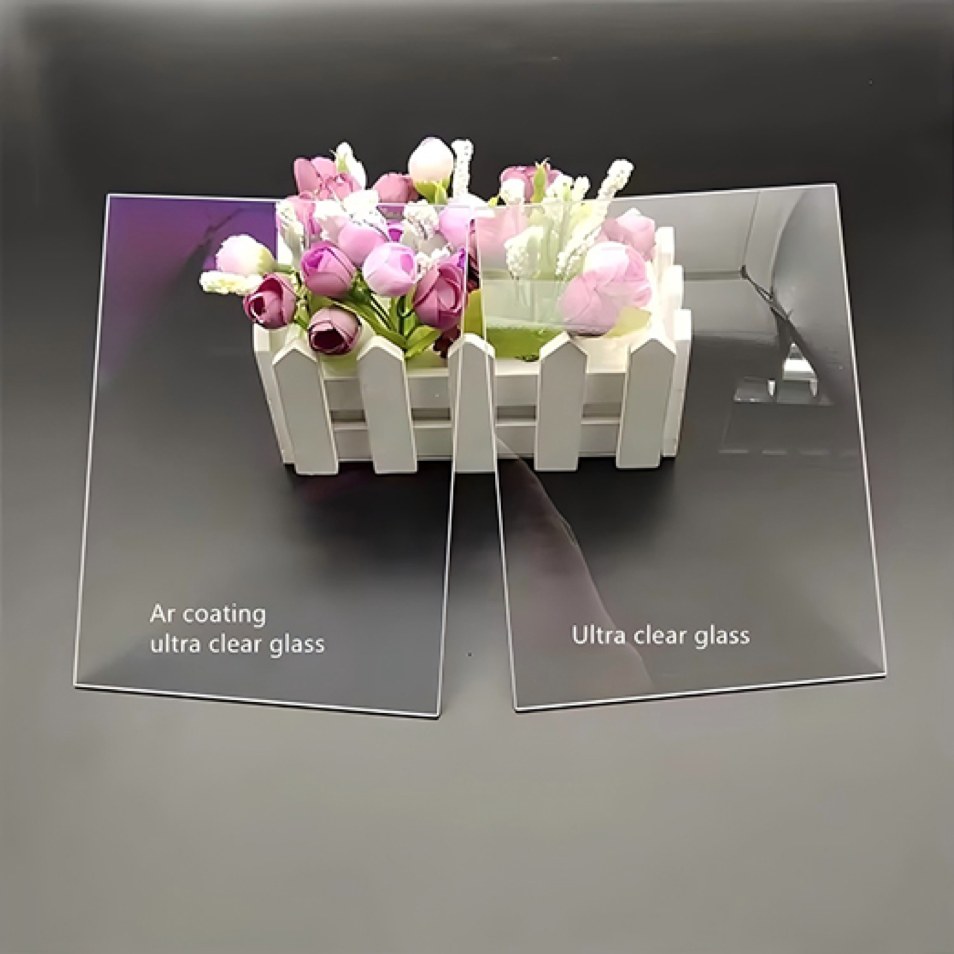
Main Processes: Vacuum coating, CVD (Chemical Vapor Deposition)
Key Performance:Reflectance can be reduced to below 1% (premium solutions <0.5%),Visible light transmittance up to 93%–99%+
Advantages: Sharper image, higher contrast, supports single-side or double-side coating
Typical Applications: High-definition displays, precision instruments, premium consumer electronics, museum display cases, automotive displays, and applications requiring high transmittance with low reflection.
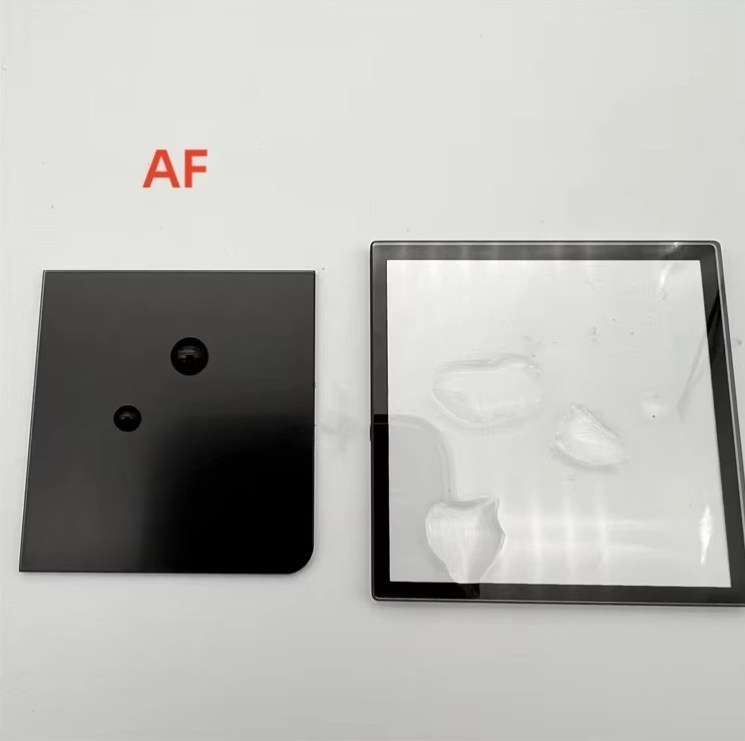
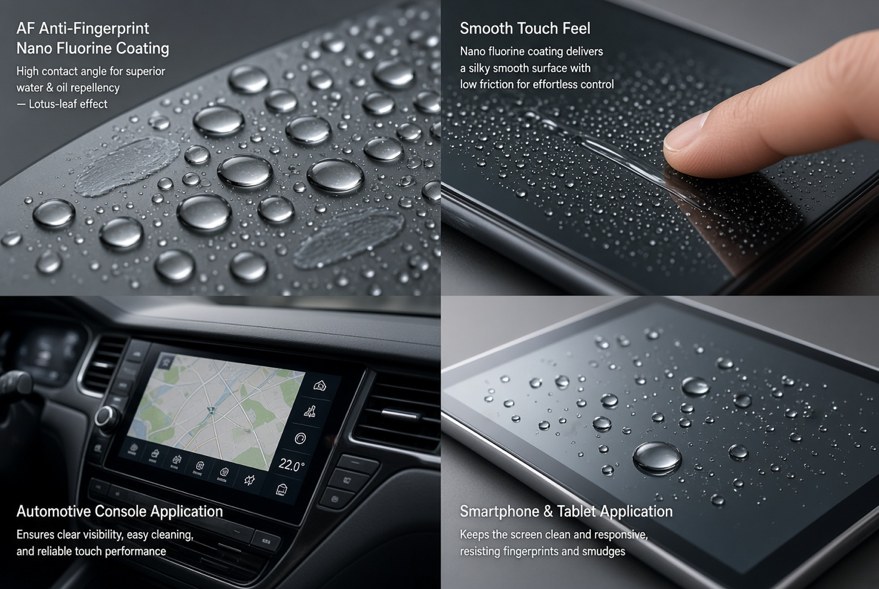
Based on the lotus-leaf effect, a nano-scale fluorine-containing low-surface-energy coating is deposited on the glass surface to achieve hydrophobic and oleophobic properties for easy cleaning.
Main Processes: Vacuum evaporation, spray + curing
Key Indicators: Water contact angle ≥110° (premium ≥115°), Coating thickness approx. 10–50 nm, Maintains high contact angle after abrasion testing
Advantages: Minimal impact on optical performance, smooth touch feel, fingerprints and oil stains wipe off easily
Typical Applications:Smartphone / tablet / laptop touchscreens, automotive center consoles,public touch terminals, and high-frequency self-service devices
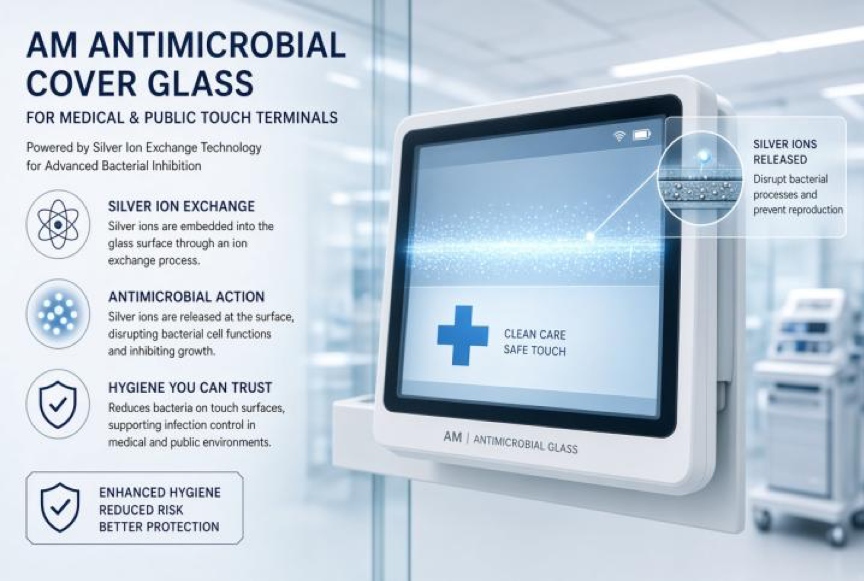
Silver/copper ions are introduced via ion exchange, or nano antimicrobial coatings are applied to inhibit bacterial and microbial growth.
Main Processes: Ion exchange method (combined with chemical strengthening), antimicrobial coating composite
Key Features: Antimicrobial rate up to 99%+, Good durability, Can be combined with AF/AR
Typical Applications: Medical device displays, public touch terminals, food-related equipment, and high-hygiene environments
Single treatments often cannot meet complex application requirements. We specialize in scientifically combining AG, AR, AF, and AM to achieve comprehensive performance of “anti-glare + high transmittance + easy-clean + antimicrobial.”
Common Composite Combinations & Recommended Scenarios:
AG + AF: Strong-light environments + touch cleaning needs (outdoor terminals, industrial touch)
AR + AF: High-definition display + easy cleaning (consumer electronics, precision instruments)
AG + AR + AF: Mainstream solution for automotive center consoles and premium outdoor displays
Composite Process Highlights:
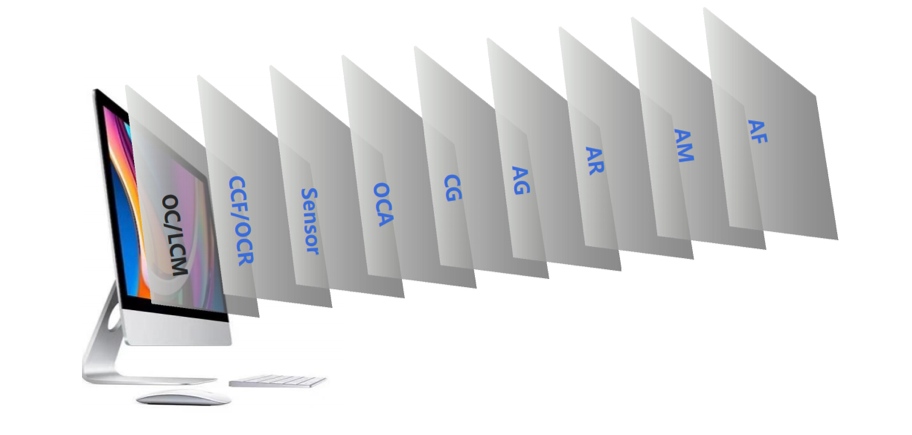
l Strict control of process sequence (typically AG etching→chemical strengthening→AR coating→ AF/AM treatment)
l Surface activation and adhesion optimization to ensure composite film stability
l Simultaneous verification of optical, abrasion resistance, contact angle, and antimicrobial indicators
Fuxin Glass have mature composite production lines and process validation capabilities, enabling rapid feasibility assessment and sampling based on customer drawings and specifications.
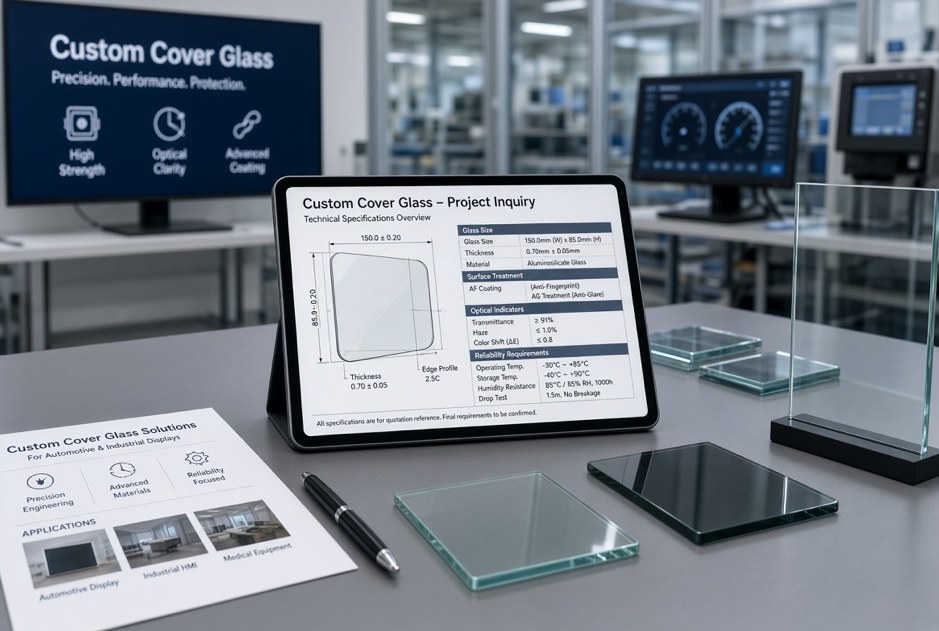
You can provide 2D/3D drawings, glass dimensions, thickness, material, display module information, touch solution, surface treatment targets, and estimated volume quantity. If the project is in its early stages, you can also provide the product application and target effect, and our technical team will assist in refining key parameters.
Based on the usage environment and display requirements, we assess the feasibility of AG, AR, AF, AM, and composite treatments, while simultaneously considering glass strengthening, shape processing, silkscreen colors, functional openings, bonding methods, and subsequent assembly requirements.
Through sample comparison, we confirm display clarity, reflectivity, haze, color, touch feel, fingerprint residue, cleaning effect, and appearance consistency. For AM or projects with high durability requirements, verification is conducted according to the testing conditions agreed upon by both parties.
Before mass production,small-batch samples are used to validate process stability, assembly compatibility, touch performance, yield, and packaging and transportation risks. The final technical specifications are then finalized based on the validation results.
The mass production phase involves process control focusing on incoming materials, processing dimensions, surface finish, optical performance, appearance defects, functional coatings, and packaging and transportation. Final inspection items and judgment criteria are based on customer drawings, approval documents, or the technical agreement between both parties.
Fuxin Glass specialize in touch display cover glass, supporting collaborative projects from raw glass selection, shape processing, and strengthening to AG/AR/AF/AM surface functional treatments. For clients requiring multiple surface effects, we focus on the final display module and overall device performance, not just the parameters of a single process.
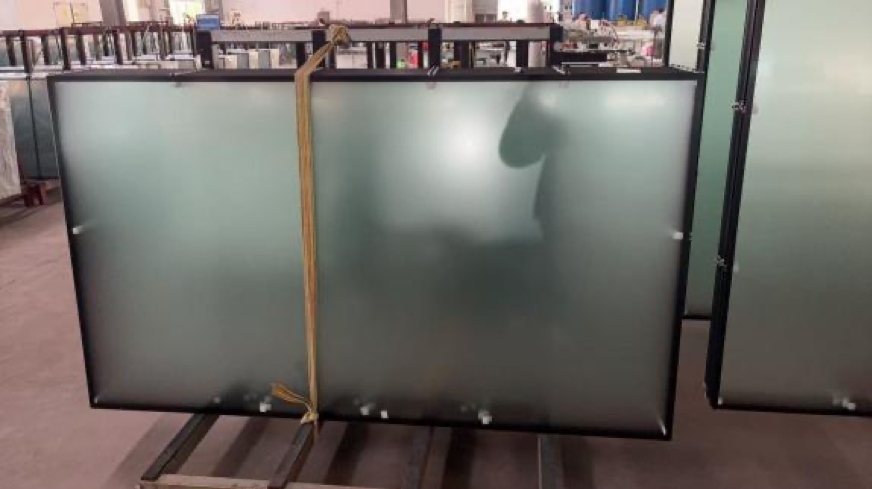
Our customized services are suitable for brand owners, display module manufacturers, touch solution providers, industrial equipment manufacturers, automotive electronics manufacturers, medical device manufacturers, and smart home manufacturers. Whether you are developing a new product or replacing an existing supplier, we can conduct technical evaluations based on drawings, samples, or target effects.
We can support projects including, custom sizes and irregular shapes, different glass thicknesses, chemical strengthening or physical tempering, AG/AR/AF/AM single treatments, multi-layer composite surface effects, screen printing or UV printing, functional drilling, chamfering and CNC machining, as well as sample and mass production (with adhesive bonding tape) applied to display modules.
Before requesting a customized solution, please prepare the following project information:
To receive a faster and more accurate response, please provide the following information in your inquiry if possible:
Application | Industrial displays, automotive, medical, outdoor terminals, smart home, or other applications |
Glass Specifications | Length, width, thickness, material, shape, rounded corners, drilling, chamfers |
Surface Treatment | AG, AR, AF, AM or multi-layer composite |
Optical indicators | Transmittance, reflectance, haze, gloss, color or color deviation requirements |
Reliability requirements | Abrasion resistance, chemical resistance, detergent resistance, temperature and humidity resistance, antibacterial properties, or other testing requirements. |
Touch and bonding | PCAP/Other touch solutions, bonding methods, display module models |
Business Information | Sample quantity, estimated annual volume quantity usage, target mass production time, and delivery regions and countries. |
If you haven't yet determined the specific parameters, you can also send product images, photos of existing glass samples, or a description of the application scenario. We will first assist you in selecting a surface treatment option based on the usage environment and target effect.
AG is primarily used to reduce glare and strong light interference. AR is mainly used to reduce surface reflection and improve display clarity. AF is mainly used to reduce fingerprint and oil stain adhesion and improve surface smoothness and cleaning experience. They address different problems and can be combined according to product needs, but final confirmation requires optical, touch, and durability verification.
Through optimized film systems and process sequences, high transmittance can be maintained while ensuring abrasion resistance. Specific indicators can be customized and supported with test data.
We support standard touch cover glass sizes and thicknesses. Special large-size, ultra-thin, or thicker requirements can be evaluated. Please provide specific specifications.
Ion exchange methods offer longer-lasting antimicrobial performance; coating methods can improve abrasion resistance and lifespan through composite processes. For medical and high-requirement scenarios, ion exchange is recommended.
Please submit your requirements (drawings, quantity, key indicators) via the form on website or contact information. We will reply with a solution and quotation within 1–2 working days.

Copyright © 2026 Fuxin Glass (Dongguan City) Technology Co., Ltd. All Rights Reserved