



FUXIN manufactures custom spray-coated AG anti-glare cover glass for Interactive Flat Panel Displays (IFPD), interactive whiteboards, smart classroom screens and corporate collaboration panels. The spray-applied micro-textured surface reduces distracting reflections from windows, ceiling lights and other bright indoor sources while preserving the clarity and touch responsiveness required by modern large-format displays.
AG Film vs AG Coating vs AG Etching
How to Choose AG Glass for Interactive Whiteboards
For IFPD projects, anti-glare performance cannot be selected by haze alone. Display resolution, panel size, sparkle, gloss, surface roughness, writing feel and large-area coating uniformity all influence the final user experience. FUXIN supports application-specific AG tuning together with strengthening, silk-screen printing, optional AF treatment and bonding preparation.
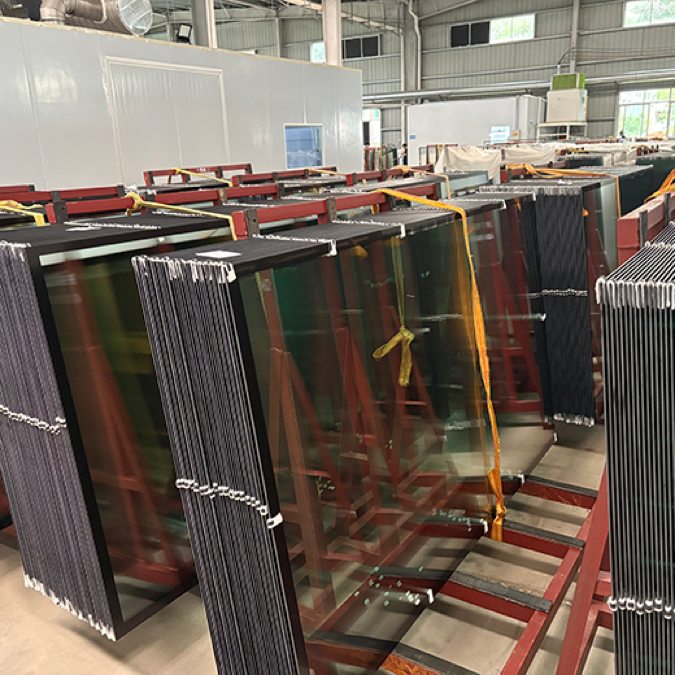
Large-format cover glass prepared for interactive display applications.
Classroom & Meeting-Room Lighting: Large interactive displays are often installed under bright ceiling lights or near windows, where glossy glass can create distracting reflections.
Large Viewing Area: Because IFPD panels are much larger than handheld screens, reflected light is more visible across the display surface.
4K Text & Icon Clarity: Education and collaboration displays show fine text, diagrams and UI elements, so AG must reduce glare without excessively softening image detail.
Writing & Annotation: Interactive whiteboards require a surface that supports finger and stylus input while maintaining a comfortable writing feel.
Long Viewing Distance: The AG design must work for both close-range writing and room-scale viewing by students or meeting participants.

Interactive flat panel display used in a bright meeting-room environment.
Spray-coated AG is attractive for large interactive displays because the coating parameters can be adjusted for the target haze, gloss and tactile feel, and the process can be adapted to large panel sizes. It is especially useful where manufacturers need a flexible balance between anti-glare performance, optical clarity and cost.
Item | Spray-Coated AG | Etched AG |
Process | Surface spray coating | Chemical micro-etching of glass |
AG Tuning | Flexible haze / gloss adjustment through coating recipe and process | Controlled by etched microstructure |
Large-Panel Production | Often attractive for large-format display programs | Depends on etching line capacity and panel handling |
Durability | Depends on coating formulation, adhesion and curing | Texture is integral to the glass surface |
Cost Position | Often competitive for volume IFPD projects | Can involve higher process complexity |
Best Fit | Cost-performance focused large IFPD programs | Premium projects requiring etched-surface durability |
Parameter | Why It Matters for IFPD |
Haze | Controls diffusion. Too little may leave strong glare; too much can reduce perceived sharpness and black contrast. |
Gloss | Defines the matte appearance and visible reflection level under ambient light. |
Surface Roughness (Ra) | Influences tactile feel, stylus drag and the strength of the matte texture. |
Sparkle | Critical for 4K and high-resolution displays; excessive sparkle can create a grainy visual effect over fine pixels. |
Transmittance | Should be evaluated on the complete glass + coating stack rather than by AG coating alone. |
Uniformity | Large panels require center-to-edge consistency in haze, gloss and appearance. |
IFPD Requirement | AG Direction |
Bright classroom | Prioritize stronger glare control while checking text clarity |
4K fine text / graphics | Prioritize lower sparkle and moderate haze |
Whiteboard writing | Balance surface roughness, finger glide and stylus feel |
Corporate meeting room | Balance reflection control with image clarity |
Window-facing installation | Give more weight to ambient-light glare reduction |
High-resolution drawing / annotation | Use low-sparkle AG and avoid overly aggressive diffusion |
55, 65, 75 and 86 inch are common size classes for interactive flat panels. As glass size increases, coating uniformity, flatness, handling, strengthening distortion and appearance consistency become increasingly important.
l Center-to-edge haze consistency
l Gloss uniformity across the viewing area
l Coating thickness and spray-path uniformity
l Low sparkle on 4K pixel structures
l Glass flatness after strengthening
l Edge quality and safe handling for large panels
l Black bezel / logo printing alignment
l Packaging and transportation protection for large glass
IFPD cover glass must work as both an optical surface and a writing interface. The AG texture should reduce glare without creating excessive stylus drag, rough finger feel or unstable touch response.
l PCAP multi-touch compatibility should be verified with the final glass thickness and sensor stack.
l Stylus writing feel should be evaluated on real samples, not inferred from haze alone.
l Too aggressive a surface texture can make writing feel rough or make fine 4K pixels appear grainy.
l Optional AF treatment can improve cleanability and finger glide when compatible with the AG surface.
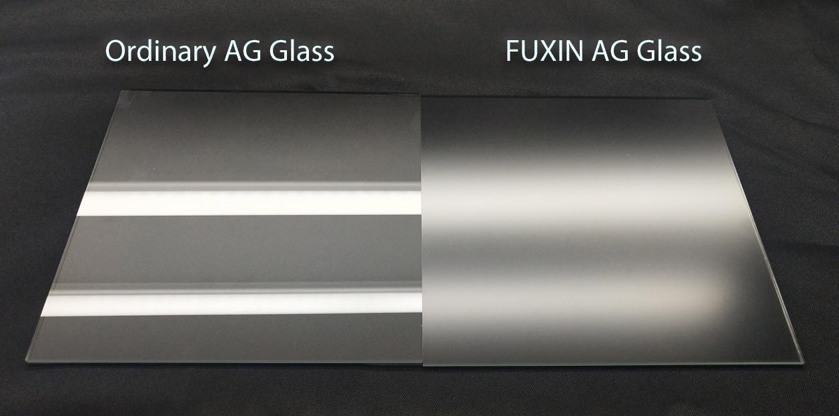
Large-format AG glass example illustrating matte anti-glare appearance across the panel.
Item | Specification / Capability |
Glass Material | Soda-lime, low-iron or aluminosilicate glass according to project requirements |
IFPD Size | Custom for 55, 65, 75, 86 inch and other large-format panels |
Thickness | Project-specific according to panel size and mechanical design |
AG Process | Spray-coated anti-glare surface |
Haze | Customized according to resolution, lighting and glare target |
Gloss | Adjustable to target appearance |
Surface Roughness (Ra) | Project-specific |
Sparkle | Low-sparkle option for high-resolution / 4K display projects |
Transmittance | Project-specific based on glass, AG level and full optical stack |
Strengthening | Thermal tempering or chemical strengthening where suitable |
Printing | Black bezel, logos, icons and sensor windows |
Optional AF | Anti-fingerprint / oleophobic top treatment where compatible |
Optional AR | Available for selected stack designs subject to compatibility review |
Bonding Preparation | OCA optical bonding or frame-bonding preparation available |
Engineering note: Avoid using one fixed haze, transmittance or hardness value as a universal IFPD specification. The target depends on display resolution, backlight, panel size, touch structure, lighting environment and the complete coating stack.
Smart Classroom IFPD: Large interactive teaching displays used for digital whiteboarding, annotation and lesson content.
Corporate Meeting & Collaboration Displays: Touch-enabled meeting-room screens used for presentations, video collaboration and shared annotation.
Interactive Whiteboards: Education and training displays where glare reduction, writing feel and text clarity must be balanced.
Digital signage and other large-format interactive screens can also use spray-coated AG glass, but they should remain secondary applications so the page stays focused on IFPD search intent.
Information | What to Provide |
Panel Size | 55 / 65 / 75 / 86 inch or custom dimensions |
Glass Drawing | Overall size, active area, corner radius, holes and edge requirements |
Display Resolution | 4K or other resolution / pixel density if known |
AG Target | Haze, gloss, Ra, sparkle or reference sample |
Glass Thickness | Required thickness or mechanical target |
Strengthening | Thermal or chemical requirement |
Printing | Black bezel, logo, icon and sensor-window artwork |
Touch System | PCAP / IR / other interactive structure |
Optional Surface Function | AF, AR or combined treatment |
Bonding | OCA optical bonding, frame bonding or customer assembly |
Quantity | Prototype quantity and annual production volume |
The best AG glass balances glare reduction with image clarity, low sparkle and touch / writing feel. The target haze and gloss should be selected from the display resolution, lighting environment and application rather than using one universal AG grade.
Yes. Spray-coated AG can be used for 4K IFPD when haze, roughness and sparkle are controlled so that glare is reduced without unnecessarily softening fine text or creating a grainy visual effect.
There is no single ideal haze level. Bright classrooms may need stronger glare control, while 4K fine text and graphics usually benefit from lower haze and low sparkle. Sample validation is recommended.
AG itself does not prevent touch operation, but the complete glass thickness, surface texture, sensor stack and bonding structure should be validated. Surface roughness also influences stylus and finger feel.
Sparkle is a grain-like visual effect caused by interaction between the AG surface texture and the display pixel structure. It is especially important on high-resolution displays where excessive sparkle can reduce perceived image quality.
Yes. FUXIN supports custom large-format AG cover glass for common IFPD size classes such as 65, 75 and 86 inch, subject to the final glass dimensions, thickness, strengthening and coating requirements.
Spray-coated AG uses a deposited anti-glare layer and offers flexible tuning of haze and gloss. Etched AG creates the micro-texture directly in the glass surface and is often selected where integral surface durability is a priority.
Yes. Compatible AG + AF constructions can combine glare reduction with easier cleaning and smoother finger glide. The final surface should be validated for optical appearance and writing feel.
Yes. AG cover glass can be prepared for OCA or other compatible optical-bonding processes when the panel structure, coating stack and adhesive are suitable.
Provide the panel size, glass drawing, thickness, display resolution, AG target or reference sample, strengthening, printing artwork, touch structure, bonding requirement, prototype quantity and expected annual volume.

Copyright © 2026 Fuxin Glass (Dongguan City) Technology Co., Ltd. All Rights Reserved