



 2026-09-29
 46
46 Silk screen printing is widely used on touchscreen cover glass to create black bezels, logos, icons, masking layers and functional windows. For AG anti-glare cover glass, printing must be integrated carefully with the AG surface, strengthening process, bonding structure and display optical requirements.
In many touchscreen designs, the AG function is on the user-facing side while the printed black mask is placed on the rear side of the cover glass. This separation allows the front surface to control glare while the rear print layer provides decoration, light blocking and functional masking.
Quick answer: Screen printing is especially suitable for repeat-production cover glass that needs opaque black borders, controlled functional windows and consistent registration. Digital printing is more attractive when the artwork requires many colors, gradients, variable data or short-run flexibility.
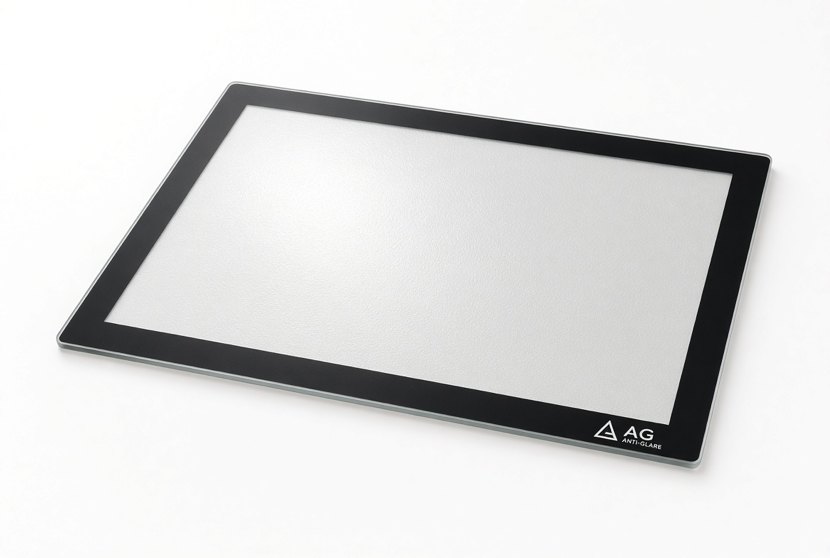
AG cover glass with a printed black bezel: the AG surface manages glare while the printed border provides masking and product decoration.
Printed Feature | Purpose |
Black Bezel / Black Mask | Blocks unwanted backlight and hides the display or touch-module structure outside the active viewing area. |
Logos & Branding | Adds product identity without using a separate label or overlay. |
Icons & Markings | Provides permanent button labels, symbols or interface graphics. |
Sensor / Camera Windows | Defines clear, tinted or functional windows for ambient-light sensors, proximity sensors, cameras or LEDs. |
IR Functional Areas | May use an unprinted aperture or a project-specific IR-transmitting ink, depending on wavelength, sensor design and optical requirement. |
Multi-Layer Printing | Multiple passes can be used when higher opacity, color build or special functional behavior is required. |
For many display cover-glass designs, printing is placed on the rear surface so the graphic and black-mask layers are protected inside the assembly. The front AG surface remains exposed to the user for glare control and touch interaction.
However, the exact layer order is project-specific. If the glass uses AR, AF, AG + AF, optical bonding, rear-side coatings or special sensor windows, the complete surface stack should be reviewed before freezing the print side and process sequence.
High Opacity: Screen printing can deposit a relatively substantial ink film, which is useful for black masking and light blocking.
Repeatable Registration: Once the screen and fixture are validated, the process is well suited to repeated border, logo and window geometry.
Solid Spot Colors: Black, white and other defined colors can be produced with controlled ink systems and approved color references.
Functional Window Control: The artwork can define clear windows, tinted areas and multi-pass masks around sensors or LEDs.
Scalable Production: The setup cost is amortized effectively when the same artwork is repeated across medium- or high-volume production.
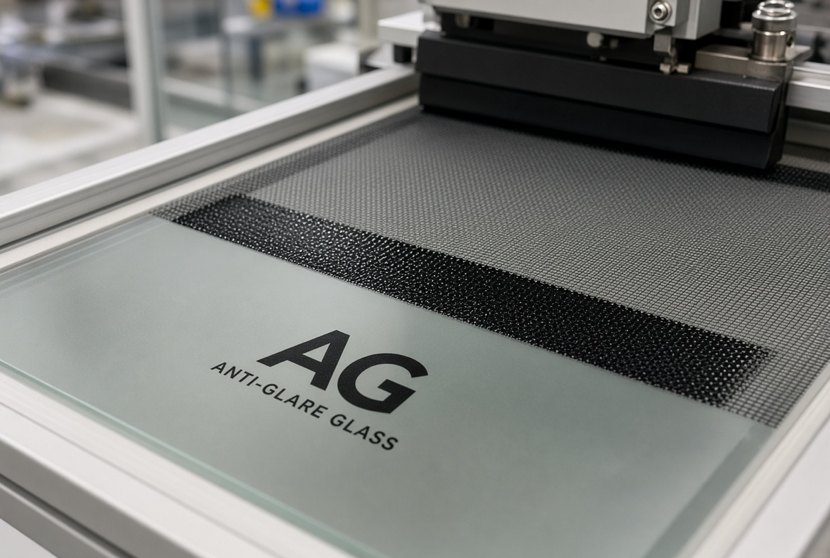
Screen-printing process on display cover glass: screen mesh, ink selection, alignment and curing determine final print quality.
Screen printing and digital printing are complementary rather than universally superior or inferior. The best method depends on artwork, required opacity, production volume, color complexity and durability requirements.
Factor | Screen Printing | Digital Printing |
Best Artwork | Black borders, spot colors, logos, simple repeated graphics | Complex graphics, gradients, photographic or many-color artwork |
Setup | Requires screen / stencil preparation | Prints directly from digital artwork |
Repeat Volume | Very suitable for repeat medium- and high-volume runs | Attractive for short runs, prototypes and variable designs |
Ink Build / Opacity | Strong option for opaque masks and solid-color layers | Depends on printer, ink and number of passes |
Variable Data | Not practical because the screen is fixed | Suitable for changing IDs, codes or artwork |
Typical Cover-Glass Use | Black bezel, logo, sensor windows, functional masks | Complex decorative graphics and flexible short-run customization |
1. Drawing & Artwork Review: Confirm active area, black border, sensor windows, logos, datums, tolerances and print-side orientation.
2. Glass Preparation: Clean the processed cover glass and remove particles, oils and residues that can weaken ink adhesion or cause pinholes.
3. Screen / Stencil Preparation: Create the screen according to the artwork, ink system, required edge definition and print thickness.
4. Ink Selection: Choose an organic, UV-curable, ceramic or other project-approved glass ink according to the strengthening sequence and durability target.
5. Alignment & Printing: Register the glass to the approved datum and apply ink under controlled squeegee pressure, speed and angle.
6. Flash / Intermediate Cure: Multi-color or multi-pass designs may require controlled intermediate curing before the next layer.
7. Final Cure / Firing: Cure the ink using the validated thermal, UV or firing process specified for that ink system.
8. Inspection: Verify registration, color, opacity, edge quality, pinholes, adhesion and dimensional conformity.
There is no single process sequence for every printed cover glass. The correct order depends mainly on the ink chemistry and the strengthening route.
Ink / Process | Typical Sequence | Engineering Note |
High-Temperature / Ceramic Ink | For ceramic-frit systems designed for heat-treated glass, printing is commonly completed before thermal tempering / heat strengthening so the frit is fired and fused during the heat-treatment cycle. | Use only when the glass, frit system, thickness and thermal process are validated for the required firing cycle. |
Low-Temperature Organic Ink | The sequence can be before or after chemical strengthening depending on the glass, ink chemistry and salt-bath compatibility. Many projects print after strengthening, while some validated systems permit printing before chemical toughening. | Do not assume one universal sequence; verify adhesion, chemical resistance and strengthening compatibility on the actual glass / ink system. |
UV-Curable Ink | UV-curable inks do not require a high-temperature firing step. Their position in the process flow should be selected around the glass strengthening and coating sequence and validated on the actual stack. | Confirm adhesion, abrasion, chemical resistance and any subsequent bonding compatibility after the final cure. |
Important: Do not use one universal curing temperature, mesh count or printing sequence for every AG cover-glass project. Screen mesh, ink-film build, curing conditions and the order relative to thermal or chemical strengthening are ink-, glass- and artwork-specific and should be validated with the selected material system.
A black border can look visually black under room light but still leak display backlight. For touchscreen cover glass, buyers should define light-blocking performance as a functional requirement rather than approving color by appearance alone.
l Define the masked area and active-viewing-area boundary on the drawing.
l Specify the required light-blocking / optical-density target when backlight leakage is critical.
l Check pinholes and local thin spots under backlight inspection.
l Use multiple print passes only when needed to achieve the approved opacity and step height.
l Confirm that the final black mask does not interfere with camera, ambient-light or proximity-sensor windows.
A 'sensor window' is not just a color patch. The correct design depends on the sensor wavelength, required transmission, visible appearance and the layers behind the glass.
Some designs use a completely clear aperture. Others use tinted or IR-transmitting ink so the sensor remains hidden visually while still receiving enough signal. The buyer and supplier should agree the wavelength range, transmission target, window dimensions and print-stack design before production.
Printed black borders create a physical step on the rear surface of the cover glass. This matters when the part will be laminated with OCA, OCR or another bonding layer.
If the adhesive layer cannot accommodate the printed step, the assembly may be more sensitive to trapped air, local stress or incomplete wet-out near the ink edge. For optical-bonding projects, printing thickness, number of ink passes, OCA thickness and active-area geometry should be reviewed as one stack.
QC Item | What to Verify |
Registration | Border, logo and window position relative to glass datums and active area |
Edge Definition | No unacceptable bleeding, saw-tooth edge or pattern deformation |
Opacity / Light Blocking | No unacceptable backlight leakage in masked areas |
Color | Approved black / white / custom color against agreed master or ΔE requirement |
Pinholes / Voids | No visible defects in critical black-mask areas |
Adhesion | Ink remains bonded after the agreed tape / cross-hatch or project-specific adhesion test |
Chemical Resistance | Ink withstands specified cleaners, alcohols or process chemicals |
Abrasion Resistance | Printed areas meet the agreed rubbing / wear requirement |
Print Step Height | Compatible with OCA, frame bonding or adhesive assembly |
AG Surface Protection | No contamination, overspray or handling damage on the functional AG side |
Defect | Possible Cause to Investigate |
Pinholes | Dust, contamination, poor ink flow or insufficient print coverage |
Jagged / Fuzzy Edges | Screen condition, artwork resolution, mesh selection, squeegee or registration issue |
Ink Peeling | Poor surface preparation, incompatible ink or incomplete cure |
Backlight Leakage | Insufficient opacity, local thin area or pinhole |
Color Variation | Ink batch, mixing, film build or curing variation |
Misregistration | Fixture, datum, screen stretch or alignment error |
Bubbles Near Printed Edge After Bonding | Print step height and adhesive / lamination stack not sufficiently matched |
Information | What to Provide |
2D Glass Drawing | Overall dimensions, active area, holes, cutouts, edge profile and tolerances |
Print Artwork | AI / PDF / CAD or approved vector artwork with layer definition |
Print Side | Front / rear surface and relation to AG, AR or AF treatment |
Color | Black / white / Pantone / master sample / ΔE requirement |
Opacity | Light-blocking or optical-density requirement if applicable |
Sensor Windows | Wavelength, transmission target, dimensions and visible-color requirement |
Ink System | Customer-specified ink or required temperature / chemical / UV durability |
Strengthening | Thermal tempering or chemical strengthening |
Bonding | Frame bonding, OCA / OCR optical bonding or pre-applied adhesive |
Quantity | Prototype quantity, annual volume and number of colors / print passes |
As an experienced factory focused on AG anti-glare cover glass for touch displays, Fuxin Glass offer fully customized silk screen printing solutions—from prototype samples to mass production. We control the entire process chain, including glass cutting, CNC machining, chemical strengthening, AG coating, precision printing, and final inspection, to deliver consistent quality and competitive lead times. Whether you need standard black-border designs, multi-color logos, or specialized functional printing for IR and sensor areas, our team can support your project with technical expertise and reliable supply.
Spray Coated AG Glass for Interactive Flat Panel Displays
Screen printing is well suited to repeated black bezels, solid spot colors, logos and functional windows because it can provide strong opacity, repeatable registration and scalable production.
In many touchscreen designs the black border is printed on the rear surface while the AG surface remains on the user-facing side. The exact layer order depends on the complete coating, sensor and bonding stack.
Rear-side printing normally performs a different function from the front AG surface, but contamination, overspray or an incorrect layer sequence can still affect optical performance. The complete finished part should therefore be inspected.
Screen printing is especially suitable for repeated opaque borders and spot-color functional graphics. Digital printing is more flexible for complex images, gradients, many colors, variable data and small production runs.
Yes. Depending on the sensor design, the window may be clear, tinted or printed with a compatible IR-transmitting ink. The wavelength and transmission requirement should be defined by the device engineer.
It depends on the ink system. Ceramic or high-temperature ink may be fired with a compatible heat-treatment process, while low-temperature organic or UV-curable inks are commonly applied after major strengthening steps.
Opacity can be checked using an agreed light-blocking or optical-density requirement together with backlight inspection for pinholes, thin areas and leakage.
Yes, but the printed ink creates a step height on the rear surface. Ink thickness, number of print passes, OCA thickness and bonding geometry should be reviewed together to avoid poor wet-out or bubbles near the print edge.
Typical checks include registration, edge definition, color, opacity, pinholes, adhesion, chemical resistance, abrasion resistance, print step height and protection of the functional AG surface.
Vector artwork such as AI, PDF or CAD is preferred, together with the glass drawing, color references, print-side definition, sensor-window requirements and dimensional tolerances.

Copyright © 2026 Fuxin Glass (Dongguan City) Technology Co., Ltd. All Rights Reserved