



Optical bonding is used when a touchscreen or display needs better optical integration than a conventional air-gap assembly can provide. In a full optical bonding structure, cover glass is bonded to the touch sensor or display using optically clear adhesive such as OCA. The adhesive occupies the internal gap between layers after lamination, creating a continuous optical stack and reducing the number of glass-air interfaces inside the display.
FUXIN supports custom cover glass for OCA-based display assemblies, including glass processing, strengthening, silk-screen printing, AG / AR / AF surface treatments, adhesive preparation and downstream optical-bonding support. The correct solution depends on display size, touch structure, outdoor-readability target, operating environment and assembly process.
AG Cover Glass with Pre-Applied OCA Cover Glass Mounting & Adhesive Solutions
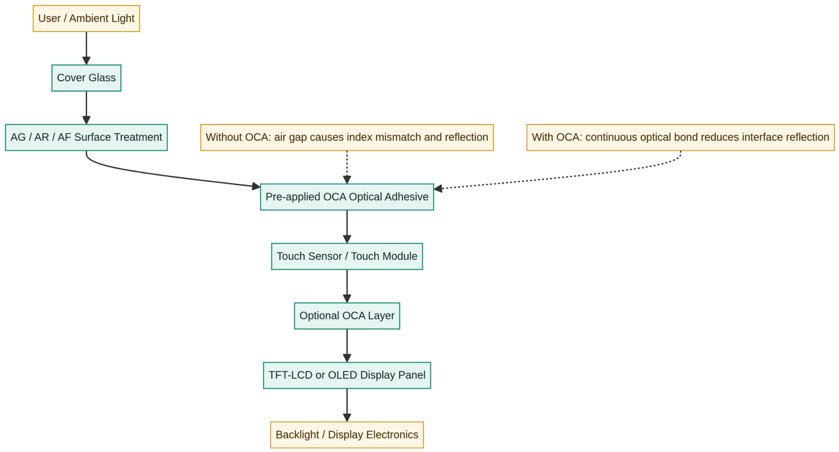
Typical optical-bonding stack showing cover glass, surface treatment, OCA, touch layer and display module.
OCA is a solid optically clear adhesive film used between transparent display layers. During lamination, the film conforms to the bonded surfaces and replaces the internal air gap within the laminated area. Because the optical path becomes more continuous, internal interface reflections and parallax can be reduced compared with an unbonded air-gap structure.
For engineering purposes, OCA should be selected by the complete module requirement rather than by one optical number alone. Important factors include optical transmission, haze, refractive index, film thickness, adhesion, temperature / humidity reliability, UV exposure, print-step compensation and rework requirements.
Item | Air-Gap / Frame-Bonded | Full Optical Bonding |
Internal Structure | Cover glass separated from sensor/display by air | Cover glass bonded to sensor/display with optically clear adhesive |
Internal Reflection | More glass-air interfaces | Fewer glass-air interfaces in the bonded area |
Parallax | Higher potential parallax | Reduced parallax and tighter optical stack |
Dust / Condensation | Internal cavity can remain | Bonded area has no open internal air gap |
Assembly Cost | Generally lower | Higher process and material cost |
Serviceability | Often easier to separate layers | Repair and rework can be more process-dependent |
Best Fit | Cost-sensitive indoor displays, simple HMIs | Outdoor, automotive, medical, rugged and high-value touch displays |
Outdoor Readability: Reducing internal reflections can help preserve display contrast under bright ambient light when combined with the correct front-surface treatment and backlight design.
Touch Precision: A tighter optical stack can reduce parallax between the visible image and touch surface, which is useful for precise touch, stylus and small UI elements.
Mechanical Integration: Bonded layers behave more like one assembly and can distribute mechanical stress differently than a loose air-gap stack.
Dust & Moisture Control: The bonded optical area does not contain the same open cavity found in conventional air-gap structures, helping reduce contamination or condensation between bonded layers.
Thin Product Design: Removing a mechanical air gap can support thinner, more integrated module structures where the overall design allows it.
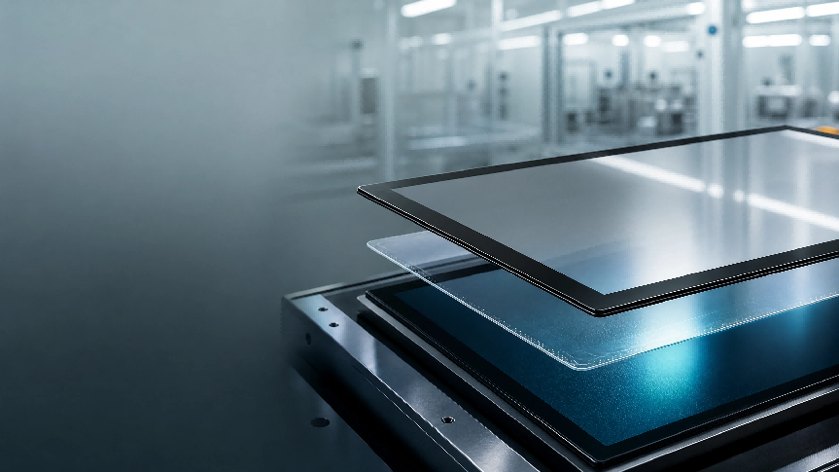
Exploded-view illustration of cover glass, OCA and display layers used in an optical-bonding assembly.
The strongest Application-page value comes from showing when optical bonding is justified. The following use cases are more useful than listing every industry with equal weight.
Industrial HMI & Rugged Controls: Factory panels, outdoor terminals and machine interfaces exposed to vibration, dust or strong ambient light. Optical bonding is most valuable when display readability and mechanical integration justify the added process cost.
Outdoor Kiosks & EV Charging Displays: Public interfaces exposed to sunlight or changing outdoor lighting can benefit from a bonded optical stack combined with AG or AR front-surface treatment.
Automotive Displays: Center information displays, clusters and selected in-vehicle touch interfaces often require careful control of reflections, temperature cycling, vibration and long-term optical stability.
Medical Displays & Diagnostic Equipment: Patient monitors, diagnostic systems and clinical interfaces can benefit from low parallax, good readability and a sealed internal optical area, provided the OCA is validated for the device environment and cleaning requirements.
Premium Consumer & Portable Devices: Thin tablets, handheld terminals and specialized devices can use OCA when module thickness, touch precision and optical integration are important.
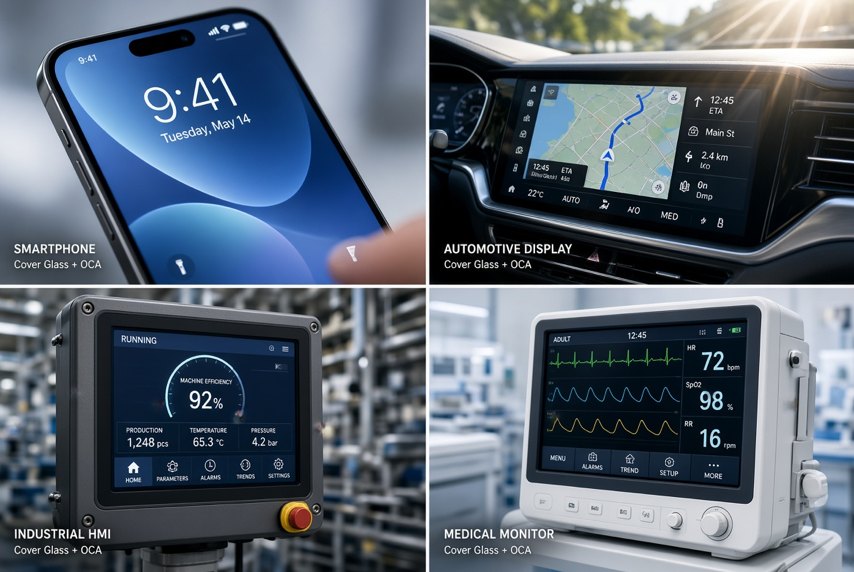
Representative application scenarios for OCA-bonded cover glass: consumer, automotive, industrial and medical displays.
OCA solves an internal optical-interface problem. AG, AR and AF solve different front-surface problems. Combining them correctly is often more effective than asking one treatment to do everything.
Technology | Primary Function | Typical Application Value |
AG Anti-Glare | Diffuses disturbing ambient reflections at the front surface | Industrial HMI, kiosks, bright indoor / outdoor interfaces |
AR Anti-Reflective | Reduces front-surface reflection while preserving a clear surface | Premium optical displays, high-contrast interfaces |
AF Anti-Fingerprint | Reduces fingerprint and oil adhesion | Frequently touched medical, industrial and consumer interfaces |
OCA Optical Bonding | Reduces internal air-gap interfaces after lamination | Display-stack integration between cover glass, touch sensor and display |
l Cover-glass and touch-sensor materials
l Display size and active bonding area
l OCA film thickness and step-height compensation
l Optical targets: transmittance, haze, reflectance and color
l Operating temperature and humidity
l UV exposure and long-term yellowing requirement
l Printing thickness around black borders and icons
l Need for AG / AR / AF surface treatment
l Vacuum-lamination equipment and process window
l Rework, repair and serviceability requirements
OCA is a dry film and provides controlled adhesive thickness, while OCR / LOCA is dispensed as a liquid and then cured. Neither route is universally better. The preferred process depends on module geometry, display size, step height, equipment, takt time and rework strategy.
Item | OCA | OCR / LOCA |
Adhesive Form | Solid film | Liquid resin |
Thickness Control | Defined by selected film thickness | Controlled by dispensing volume and module geometry |
Handling | Film lamination and release-liner handling | Dispensing, flow and curing |
Flat Structures | Strong fit for repeatable flat-panel assemblies | Also possible |
Complex Gaps / Geometry | Depends on film conformability and step height | May offer more flexibility in some structures |
Process Selection | Best when the module is designed around film lamination | Best when liquid fill and cure fit the module design |
Application Requirement | Recommended Starting Point |
Strong ambient light / outdoor readability is a priority | Strong candidate for optical bonding; also review AG/AR front surface |
Precise touch or stylus performance is important | Optical bonding can help reduce parallax |
Dust / condensation between layers is a concern | Bonded optical stack can reduce open internal cavity risk |
Lowest assembly cost is the main priority | Air-gap / frame-bonded design may be more suitable |
Easy field replacement of display layers is required | Evaluate serviceability before choosing full bonding |
Premium industrial / automotive / medical display | Optical bonding is often worth evaluating |
Information | What to Provide |
Cover Glass Drawing | Dimensions, active area, holes, cutouts, edge profile and tolerances |
Display Stack | Cover glass / touch sensor / LCD or OLED structure and supplier drawings |
OCA Requirement | Specified brand / model if approved, or optical and reliability targets for selection |
Bonding Area | Full-area or project-defined optical bonding zone |
Print Step Height | Black border and ink thickness that the adhesive must accommodate |
Surface Treatment | AG, AR, AF or other front-surface requirement |
Reliability | Temperature, humidity, UV, vibration and chemical requirements |
Assembly | Vacuum laminator, autoclave / debubbling process, pressure and temperature limitations |
Rework | Whether bonded-layer replacement or repair is required |
Quantity | Prototype quantity and expected annual volume |
OCA optical bonding uses a transparent adhesive film between cover glass and the touch sensor or display. After final lamination, the adhesive occupies the bonded internal gap and creates a more continuous optical stack.
Air-gap assemblies leave a physical gap between the cover glass and underlying display stack, while full optical bonding fills the bonded interface with OCA or another optical adhesive. Full bonding can reduce internal reflection and parallax but adds process cost and affects rework strategy.
It can improve ambient contrast by reducing internal optical interfaces. Final outdoor readability still depends on the display brightness, front-surface AG/AR treatment, cover-glass design and overall optical stack.
Yes, when the HMI needs better optical integration, lower parallax or a more sealed internal optical area. The selected OCA should be validated for the required temperature, humidity, vibration and lifetime.
Choose based on module geometry, step height, equipment, thickness control and rework needs. OCA is a dry film with controlled thickness; OCR / LOCA is liquid and can offer more flexibility for some structures.
Yes. The front-surface treatment and rear-side bonding structure perform different functions. Compatibility should be validated for the complete glass, printing, OCA and display stack.
No. Pre-applied OCA means the adhesive film has already been laminated to the cover glass. Full optical bonding is completed only after the cover glass is finally laminated to the touch sensor or display module.
Provide the cover-glass drawing, display-stack drawing, active area, print geometry, OCA requirement, bonding area, reliability conditions, equipment limitations and expected volume.







Copyright © 2026 Fuxin Glass (Dongguan City) Technology Co., Ltd. All Rights Reserved