



Cover glass protects the front of a touchscreen, HMI or display, but it must also be securely integrated into the final device. The correct mounting method depends on the housing material, bezel design, display stack, bond-line thickness, operating environment and whether the glass is mounted to a frame or optically bonded to the display.
FUXIN supports custom processed cover glass together with pre-applied mounting adhesives, die-cut adhesive frames and optical bonding preparation. Depending on the project, the solution may use acrylic transfer adhesive, 3M VHB-type foam tape, perimeter/frame bonding, or OCA/OCR optical bonding.
Use transfer adhesive or VHB-style tape when the cover glass is attached to a bezel, housing or equipment panel. Use OCA or OCR when the cover glass must be optically bonded directly to a touch sensor or display within the active viewing area.
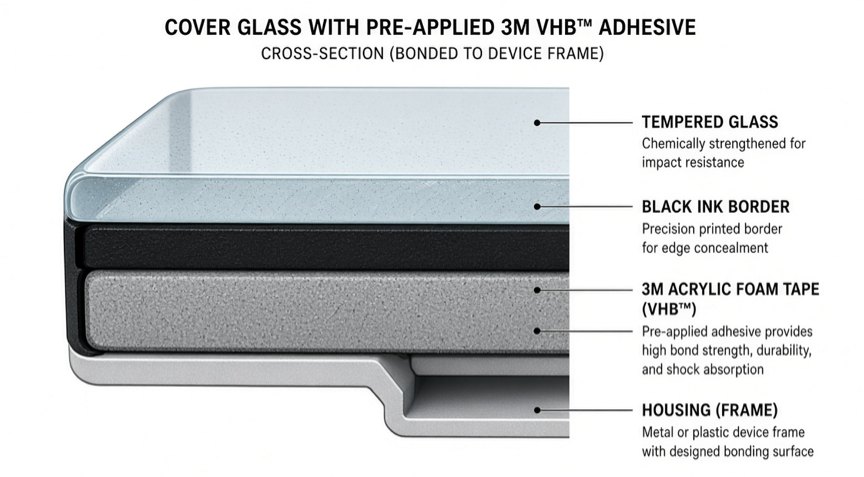
Typical cover-glass mounting structure with glass, printed border, adhesive layer and device housing.
Thin acrylic transfer adhesives are commonly used for flat bezel and housing attachment. They can be die-cut into perimeter frames, strips or custom zones and pre-applied to the rear side of the cover glass before shipment.
Best for thin bonding lines and flat mounting surfaces
Commonly applied outside the active display area
Useful for printed borders, overlays and HMI front panels
Adhesive grade should be selected according to substrate surface energy, temperature and chemical exposure
Acrylic foam tapes are useful when the assembly needs more gap compensation, vibration damping or structural compliance than a thin transfer adhesive can provide.
Helps accommodate small assembly tolerances and surface variation
Provides viscoelastic behavior for shock and vibration absorption
Can support sealing around the perimeter when the design is validated
Thickness and foam construction must be matched to the housing and bond-line requirement
Perimeter bonding keeps the adhesive outside the active viewing area and is common in industrial HMI, machine controls, kiosks and equipment front panels. The adhesive geometry can be die-cut to follow the black border, mounting frame or housing structure.
Optical bonding uses optically clear adhesive such as OCA or liquid OCR/LOCA between the cover glass and touch sensor or display. Unlike perimeter mounting, the adhesive is intentionally placed within the optical path to remove the internal air gap after final lamination.
Important distinction: 3M mounting adhesive is not the same as OCA optical adhesive. They serve different assembly functions and should not be treated as interchangeable.
Project Requirement | Recommended Starting Point |
Thin, flat bezel attachment | Acrylic transfer adhesive |
Need for gap compensation or vibration damping | VHB / acrylic foam tape |
Perimeter attachment with an air-gap display structure | Frame / perimeter bonding |
Maximum optical integration between glass and display | OCA or OCR optical bonding |
Fast final assembly | Pre-applied adhesive cover glass |
Custom adhesive geometry | Die-cut adhesive frame / strips |
The adhesive should be selected from the complete mechanical and environmental design. A strong adhesive is not automatically the correct adhesive if the substrate, bond width or operating environment is unsuitable.
l Housing / bezel material and surface energy
l Bond width and available mounting area
l Glass flatness and printed step height
l Required bond-line thickness
l Temperature and humidity range
l Vibration, shock and thermal expansion
l Exposure to cleaners, oils or chemicals
l UV exposure for outdoor equipment
l Need for sealing, rework or serviceability
l Manual vs automated assembly process
Layer | Function |
Front Surface | Optional AG, AR, AF or composite surface treatment |
Cover Glass | Tempered or chemically strengthened glass |
Decoration | Black silk-screen border, icons, logos or sensor windows |
Mounting Layer | Transfer adhesive, VHB foam tape or custom die-cut adhesive frame |
Housing | Metal, plastic or other compatible mounting substrate |
Item | Pre-Applied Adhesive | Customer-Applied Adhesive |
Adhesive Die Cutting | Completed by supplier | Completed or sourced by customer |
Placement | Pre-controlled to approved drawing | Controlled during customer assembly |
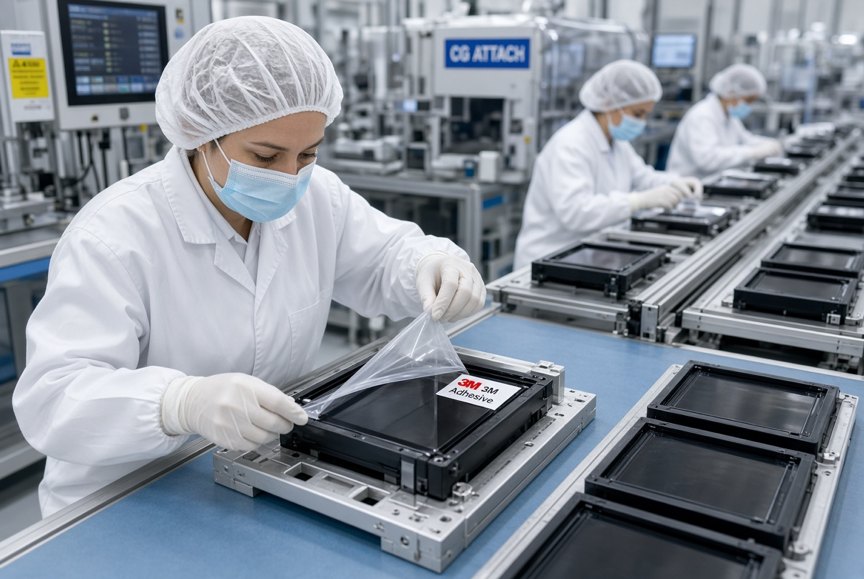
Handling Steps | Fewer | More |
Contamination Risk | Reduced adhesive handling | More adhesive handling on assembly line |
Assembly Time | Can reduce preparation steps | More preparation required |
Custom Pattern | Perimeter frame, strips or custom zones | Depends on customer process |
The mounting method should follow the device architecture. FUXIN can combine glass processing and adhesive conversion for a range of equipment interfaces.
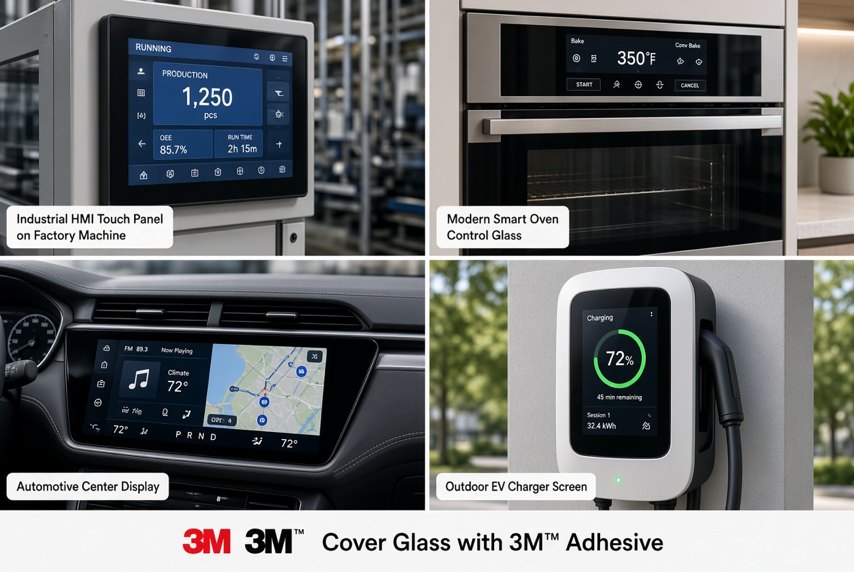
Industrial HMI & Machine Controls: AG or clear cover glass mounted to metal or plastic front housings using perimeter transfer adhesive or foam tape. Typical projects include factory automation, CNC interfaces and process-control panels.
Smart Home & Appliances: Decorative glass panels for ovens, refrigerators, washing machines, coffee machines, smart switches and wall controls, with printed borders and custom adhesive zones.
Kiosks & Public Terminals: Cover glass for self-service kiosks, POS systems, EV charging stations and digital signage where repeatable panel mounting and clean front design are required.
Medical & Laboratory Equipment: Front glass for monitors and instruments where mounting stability, cleanability and controlled adhesive placement are important.
Transportation & Automotive Interfaces: Cover glass for selected control panels and display housings where vibration, temperature and substrate compatibility must be validated.
AG Cover Glass with Pre-Applied 3M Adhesive AG Cover Glass with Pre-Applied OCA
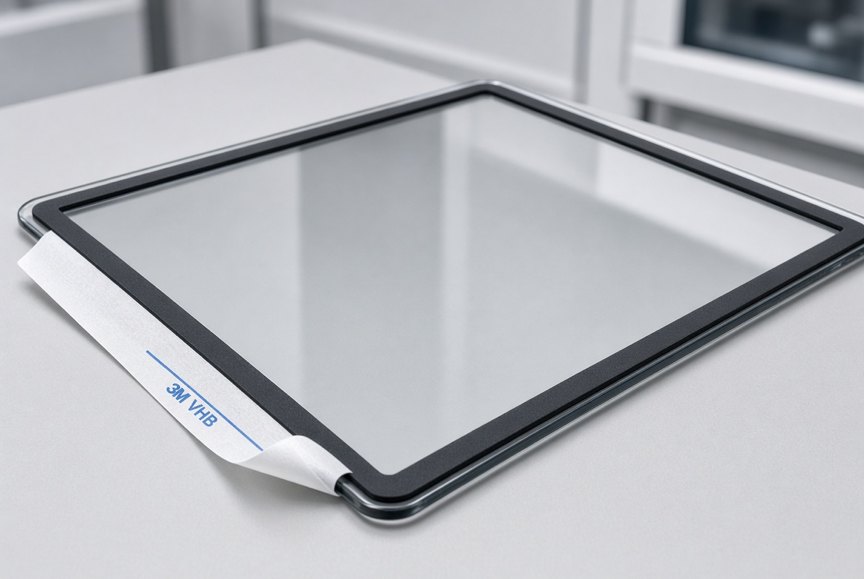
Example of adhesive-backed cover glass prepared for device assembly
Industrial HMI is one of the most common use cases for adhesive-backed cover glass. A typical assembly uses AG or clear cover glass with a black printed border, a rear-side adhesive frame and a metal or plastic enclosure. The active display area remains free from mounting adhesive while the perimeter bond secures the glass to the housing.
l Select AG level according to factory lighting and display resolution
l Keep adhesive outside the active display and optical windows
l Define sufficient bond width around the bezel
l Review printed step height and housing flatness
l Match adhesive type to metal, coated metal or plastic substrate
l Validate temperature, humidity, vibration and cleaning requirements
Capability | Options |
Glass | Soda-lime, low-iron, aluminosilicate; custom thickness, size and shape |
Processing | CNC cutting, holes, notches, stepped edges, 2.5D / 3D profiles |
Strengthening | Chemical strengthening or thermal tempering where suitable |
Printing | Black bezel, logos, icons and transparent sensor windows |
Surface Treatment | AG, AR, AF and compatible composite treatments |
Mounting Adhesive | Acrylic transfer adhesive, VHB-style foam tape, PET double-sided adhesive or other approved PSA |
Optical Adhesive | OCA or OCR/LOCA for full optical bonding projects |
Adhesive Conversion | Die-cut frame, strips, custom zones, release liner and peel tab |
Information | What to Provide |
Cover Glass Drawing | Overall dimensions, active area, holes, cutouts, edges and tolerance |
Housing / Bezel | Material, surface finish, geometry and available bonding area |
Display Structure | Air-gap, frame-bonded or optical-bonded architecture |
Glass Requirement | Material, thickness and strengthening |
Surface Treatment | AG, AR, AF or reference sample |
Printing | Black border, logo, icon and sensor-window artwork |
Adhesive Preference | Specified 3M grade, transfer adhesive, VHB-style tape or open recommendation |
Adhesive Pattern | Perimeter width, strip layout, keep-out zones and release-liner design |
Environment | Temperature, humidity, vibration, chemical, UV and cleaning requirements |
Quantity | Prototype quantity and expected annual production volume |
Common options include acrylic transfer adhesive and VHB-style acrylic foam tape. The correct choice depends on the housing material, bond width, gap, temperature, vibration and environmental requirements.
Transfer adhesive creates a thinner bond line and is well suited to flat mounting surfaces. VHB-style foam tape is thicker and can provide more gap compensation, vibration damping and structural compliance.
It can be suitable for selected flat, high-surface-energy mounting structures. The actual adhesive grade should be confirmed against the substrate, bond width and environmental requirements of the project.
Mounting adhesive is used primarily to attach cover glass to a bezel, frame or housing. OCA is optically clear adhesive used between display layers for full optical bonding within the active optical path.
Yes. Perimeter frames, strips and custom die-cut adhesive patterns can be applied to the rear side of the glass while keeping active display, sensor and optical areas free of mounting adhesive.
Bond width depends on adhesive type, substrate, glass size, load and environmental requirements. It should be defined from the mechanical design rather than using one universal width.
Yes. Compatible AG, AR or AF cover glass can be processed with pre-applied mounting adhesive when the surface stack and rear-side bonding structure are suitable.
Please provide the cover-glass drawing, housing material, mounting geometry, required adhesive zones, operating environment, assembly method and expected production volume.







Copyright © 2026 Fuxin Glass (Dongguan City) Technology Co., Ltd. All Rights Reserved