



 2026-10-08
 14
14 Choosing a cover-glass substrate is not simply a question of selecting the material with the highest alumina content. For touchscreen products, the final durability of the cover lens depends on the glass composition, chemical-strengthening response, thickness, edge quality, surface condition and device structure.
Mid-alumina and high-alumina silicate glasses are both used for chemically strengthened cover glass in consumer electronics, automotive displays, industrial HMI panels, medical equipment and smart-home controls. High-alumina grades are often selected when a project requires greater strengthening potential or a thinner construction, while mid-alumina grades can provide an attractive balance of performance, processability and cost. The correct choice should be made from the actual material grade and finished-part requirements rather than the material name alone.
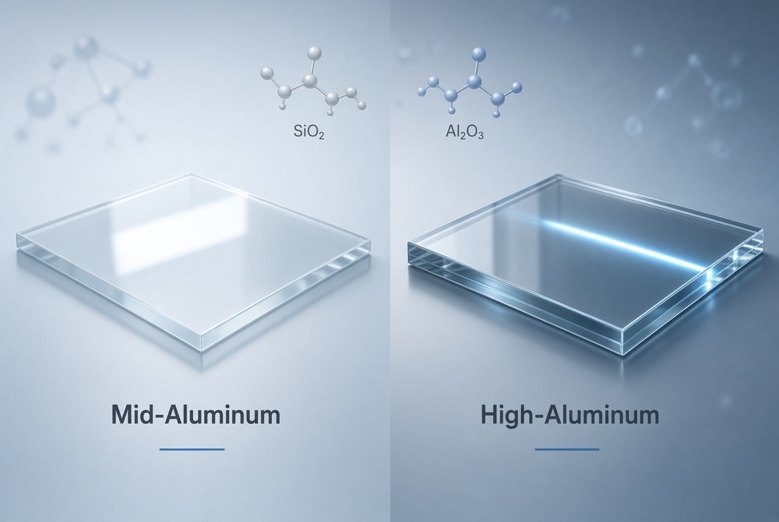
Concept illustration: mid-alumina and high-alumina cover-glass families. Actual composition and performance depend on the specific glass grade.
Both materials belong to the broader aluminosilicate family. Their glass network contains silica together with alumina and other oxides. Many cover-glass grades are designed so that sodium ions near the surface can be exchanged with larger potassium ions during chemical strengthening, creating a surface compressive-stress layer.
In supplier and factory discussions, “mid-alumina” and “high-alumina” are often used as convenient commercial categories. However, there is no single universal global Al₂O₃ cut-off that makes every grade above one percentage “high-alumina” and every grade below it “mid-alumina.” Composition should therefore be verified by the material grade and supplier documentation.
Selection Factor | Mid-Alumina Glass | High-Alumina Glass |
Material Positioning | Balanced performance/cost option within the aluminosilicate family | Higher-performance option for projects that need a larger strengthening or thin-glass design window |
Chemical Strengthening | Suitable for ion-exchange strengthening; actual result depends on grade and process | Often selected for demanding ion-exchange designs; actual CS/DOL still depend on grade and process |
Thickness Strategy | Suitable for many mainstream cover-glass thicknesses | Often considered where thinner glass must still meet demanding mechanical requirements |
Cost | Typically easier to justify in cost-sensitive projects | Typically selected when the performance benefit justifies the higher substrate/process cost |
Typical Decision Basis | Target durability, thickness, application risk and budget | Higher mechanical target, thinner design, demanding impact environment or premium reliability target |
Chemical strengthening is one of the most important reasons aluminosilicate glasses are used for touch-display cover lenses. In a typical ion-exchange process, smaller alkali ions near the glass surface are replaced by larger ions from a molten salt bath. The larger ions create compressive stress at the surface, while the interior balances that stress.
Two terms frequently used in cover-glass specifications are:
l CS (Compressive Stress): the magnitude of compressive stress near the glass surface, reported for the actual strengthened part or sample.
l DOL (Depth of Layer): the depth of the ion-exchanged compressive layer according to the agreed measurement method and instrument.
A higher CS value or deeper DOL can be useful, but neither should be evaluated in isolation. Strengthening performance is a system: composition, glass thickness, exchange time, bath temperature, potassium/sodium balance and post-processing all matter. Edge damage or deep surface flaws can also reduce the finished part’s mechanical reliability even when the measured CS is high.
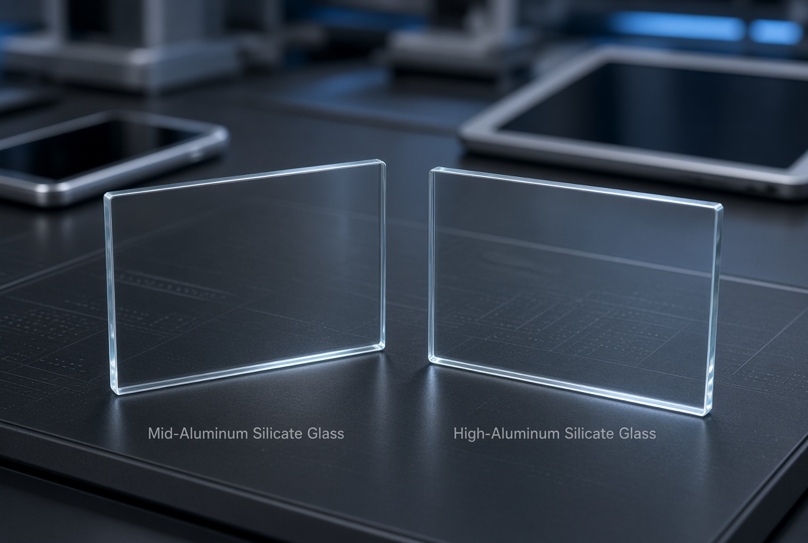
Representative transparent cover-glass samples. Final strength cannot be judged from appearance; it must be validated after processing and strengthening.
No. Alumina content is one part of the overall glass chemistry, but it is not a standalone mechanical-strength specification. Two aluminosilicate glasses with different compositions can respond differently to the same ion-exchange recipe, and two factories can obtain different results from the same substrate if strengthening conditions and finishing quality differ.
For an OEM or display integrator, the practical question is not “Which glass contains more Al₂O₃?” but rather “Which material and process combination meets the finished-part requirement?” The most useful comparison is therefore based on actual strengthened samples and the agreed product drawing.
What to Compare | Why It Matters |
Material Grade / Supplier | Exact substrate identification and datasheet |
Glass Thickness | Finished thickness after all processing |
CS | Measured compressive stress after the agreed strengthening cycle |
DOL | Measured depth of the compressive layer using the agreed method |
Edge Quality | CNC edge, chamfer, corner radius, chips and microcracks |
Surface Condition | |
Impact / Drop Test | Finished-part or module-level test matched to the product use case |
Optical Performance | Transmittance, haze, gloss, color and coating performance as applicable |
The following comparison is intentionally qualitative. It is designed to guide material selection without implying that every mid-alumina or high-alumina grade has identical properties.
Application | Mid-Alumina Starting Point | High-Alumina Starting Point |
Cost-sensitive industrial HMI | Often a strong starting point | Consider when the enclosure, impact target or thinness requirement is demanding |
Smart-home control panel | Often sufficient when the device is protected and thickness is not extremely low | Useful for premium thin designs or higher abuse resistance |
Medical display | Choose by cleaning, impact, thickness and reliability requirements | Consider where thinner glass or higher mechanical margin is required |
Automotive display | Possible for many center-stack/HMI designs after qualification | Often evaluated for demanding thermal/mechanical designs and thin premium displays |
Rugged / outdoor HMI | Use only if strengthened sample meets the impact target | Often preferred as a starting candidate for high-impact and thin designs |
Premium consumer electronics | Can be viable in cost/performance designs | Common choice when thinness and aggressive mechanical targets drive the specification |
1. Finished Glass Thickness: A thinner cover lens reduces weight and stack height but usually leaves less mechanical margin. Material selection and strengthening targets should be set together with the final thickness.
2. Strengthening Recipe: The same substrate can deliver different CS and DOL results under different ion-exchange conditions. Production control and measurement are therefore as important as the raw material.
3. Edge and Corner Quality: Glass failures often initiate at flaws. Edge chips, deep scratches, sharp internal corners or poor hole finishing can dominate real-world breakage behavior.
4. Surface Treatments: AG etching/coating, AR coating and AF coating add optical or surface functions but can change the finished stack and inspection requirements. Their compatibility with strengthening and printing should be planned early.
5. Device Structure: Frame support, adhesive, optical bonding, openings and local stress concentrations affect the finished product. Material performance should be validated in the real assembly whenever possible.
The material label alone is not enough to predict visible-light transmittance. Optical transmission depends on the specific composition, iron and impurity level, thickness, surface roughness, coatings and measurement wavelength. For example, AG treatment can reduce specular reflection but introduce haze, while AR coating can increase transmission through the finished stack.
Therefore, do not specify “high-alumina = higher transmittance” as a purchasing rule. Request the actual optical data for the thickness and surface treatment used in your project.
Scratch performance should also be separated from simple marketing labels. Pencil-hardness values such as 6H, 8H or 9H are sometimes quoted in the market, but they are highly dependent on the test method, coating, load and specimen condition and should not be used as a universal comparison of bare glass substrates.
For touchscreen cover glass, a more useful qualification plan is to define the real failure mode - cosmetic scratching, deep damage, abrasion, impact or drop breakage - and then use a test that reflects the application. AF coatings, AG surfaces and printed areas may also require their own durability tests.
RFQ Item | Information to Provide |
Application | Smart home, industrial HMI, automotive, medical, consumer device, etc. |
Glass Grade | Supplier / grade name or approved equivalent |
Thickness | Finished nominal thickness and tolerance |
Dimensions | Overall size, holes, slots, R corners, CNC profile and tolerances |
Strengthening | Chemical strengthening requirement and approved process route |
CS / DOL | Target or minimum values plus the agreed measurement method |
Impact Requirement | Ball-drop, pendulum, device-level drop or other project test |
Optical Requirement | Transmittance, haze, gloss, color or AR requirement as applicable |
Surface Treatment | AG, AR, AF, AG+AF or other functional treatment |
Printing | Black bezel, logo, sensor/IR window, color and opacity requirements |
Bonding | Frame bonding, OCA/OCR optical bonding or pre-applied adhesive |
Volume | Prototype quantity, pilot run and annual demand |
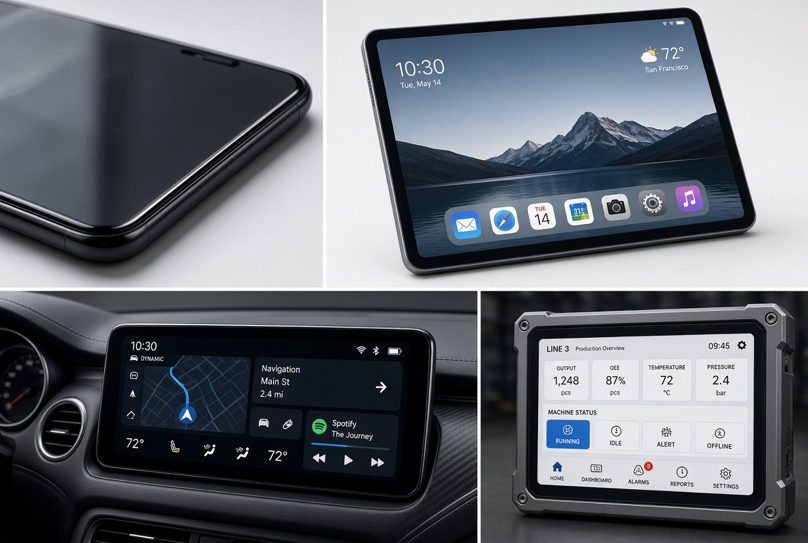
Typical cover-glass applications include smartphones, smart displays, automotive HMIs and rugged industrial interfaces.
FUXIN Glass supports custom touchscreen cover-glass projects using multiple substrate options and downstream processes. Instead of selecting a material only by the “mid-alumina” or “high-alumina” label, we can review the complete part drawing, thickness, strengthening target, optical requirement, surface treatment, printing and bonding structure.
For prototype and production projects, material selection can be verified with actual processed samples before the design is released for volume manufacturing. This is especially useful when the project combines chemical strengthening with AG, AR or AF treatment, black-border printing, sensor windows or optical bonding.
Recommended CTA: Send your cover-glass drawing, target thickness, application, strengthening requirement, surface treatment and annual volume. FUXIN can recommend a practical substrate/process combination and prepare samples for validation.
They are commercial categories within the aluminosilicate glass family. High-alumina grades generally contain more alumina and are often selected for demanding chemical-strengthening or thin-glass designs, but the exact composition boundary and finished performance vary by supplier and grade.
No. Finished strength depends on the complete glass composition, thickness, chemical-strengthening process, edge quality, surface defects and device design. Compare measured CS/DOL and application-level test results rather than the material label alone.
Both can be chemically strengthened. High-alumina grades are often considered when a project needs a wider strengthening or thin-glass performance window, but the correct choice depends on the specific grade and ion-exchange process.
Alumina changes the glass network and can influence ion-exchange behavior and material properties, but durability cannot be predicted from Al₂O₃ percentage alone. The full composition and strengthening conditions must be considered.
CS is the surface compressive stress created by ion exchange. DOL is the depth of the compressive layer according to the agreed measurement method. Both should be specified and measured on the actual strengthened glass.
Not always. Many industrial HMIs can use a properly selected and strengthened mid-alumina glass. High-alumina glass becomes more attractive when the design requires thinner glass, greater mechanical margin or demanding impact reliability.
Yes, provided the selected grade and finished cover glass meet the project’s mechanical, optical, thermal and reliability requirements. Automotive qualification should be based on the actual display design and test specification.
Check the exact material grade, finished thickness, strengthening process, CS/DOL, edge quality, impact test, optical requirements, surface treatments, printing, bonding structure and production volume.

Copyright © 2026 Fuxin Glass (Dongguan City) Technology Co., Ltd. All Rights Reserved