



 2026-09-07
 98
98 Anti-fingerprint (AF) coating is an ultra-thin oleophobic and hydrophobic surface treatment used on touchscreen cover glass to reduce fingerprint visibility, improve cleanability and create a smoother touch feel. For engineers and OEM buyers, however, initial water repellency is only one part of the specification. Film thickness and thickness uniformity can also influence abrasion durability, optical quality, tactile feel and process consistency.
AF coating thickness is sometimes described as coating depth, but film thickness or coating thickness is the more common engineering term. Because different AF chemistries and deposition methods produce very different film structures, there is no single thickness value that is universally correct for every cover-glass project.
Quick answer: A thicker AF film is not automatically better. The goal is a continuous, well-bonded and uniform low-surface-energy layer that meets both initial and post-abrasion performance requirements without introducing optical or tactile defects.
Vacuum Evaporation vs Spray AF Coating
AF Oleophobic Cover Glass for Medical Displays
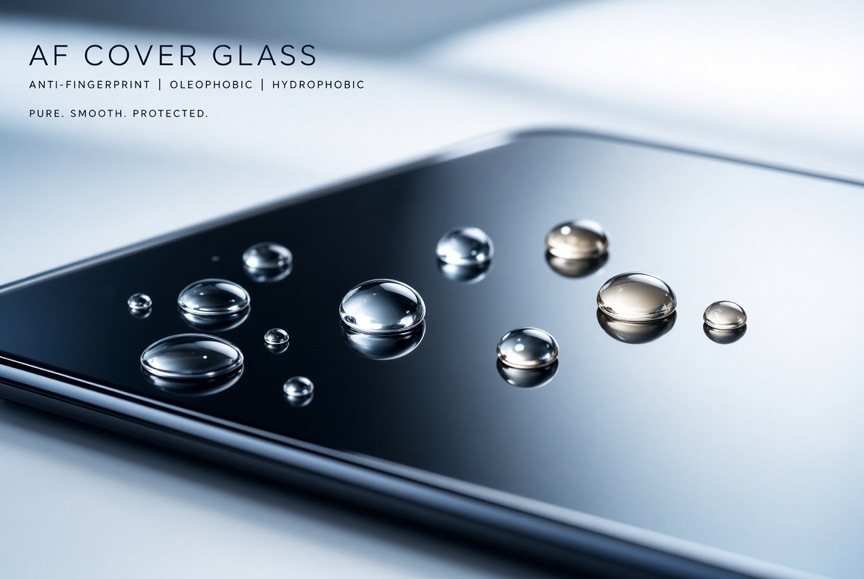
AF anti-fingerprint cover glass showing hydrophobic and oleophobic surface behavior.
AF coating thickness refers to the thickness of the functional easy-clean layer formed on the cover-glass surface after deposition and curing. The final value depends on the AF chemistry, solids concentration, deposition method, spray volume or evaporation conditions, substrate preparation and curing process.
For this reason, thickness should not be evaluated in isolation. Two AF coatings with the same nominal thickness can perform differently if one has poor surface activation, incomplete molecular bonding or large thickness variation across the panel.
Published production data and practical supplier specifications show that AF layers can range from very thin vacuum-deposited functional topcoats to thicker spray, sol-gel or hybrid easy-clean systems. The ranges below should therefore be treated as process-dependent examples, not universal industry standards.
Process Type | Thickness Characteristic | Engineering Note |
Vacuum-Deposited AF | Very thin functional top layer, often in the nanometer scale | Thickness depends on evaporation chemistry, underlayer and deposition recipe. |
Spray / Wet AF | Often thicker than vacuum-deposited AF | Strongly affected by solution concentration, atomization, spray path and curing. |
Sol-Gel / Hybrid Easy-Clean Coating | Can be significantly thicker | Not directly comparable with ultrathin fluorosilane topcoats. |
The original draft includes example ranges such as 50-200 nm for spray AF and thinner values for vacuum evaporation. Those figures can be useful as process references, but they should not be presented as mandatory targets for every chemistry or supplier.
Not necessarily. Water contact angle depends on whether the surface is sufficiently covered by low-surface-energy functional groups and whether those groups are properly bonded and oriented.
Too Thin: Incomplete or nonuniform coverage may produce lower or unstable water contact angles, inconsistent fingerprint resistance and weaker easy-clean performance.
Properly Formed: A continuous, well-bonded layer can provide stable hydrophobic and oleophobic behavior and more consistent cleaning performance.
Too Thick or Poorly Controlled: Additional material may provide diminishing returns and can increase the risk of nonuniformity, residue, tactile variation or other process defects.
A high initial water contact angle does not by itself prove long-term AF quality. For real cover-glass qualification, the more valuable question is how much hydrophobic and oleophobic performance remains after repeated wiping or controlled abrasion.
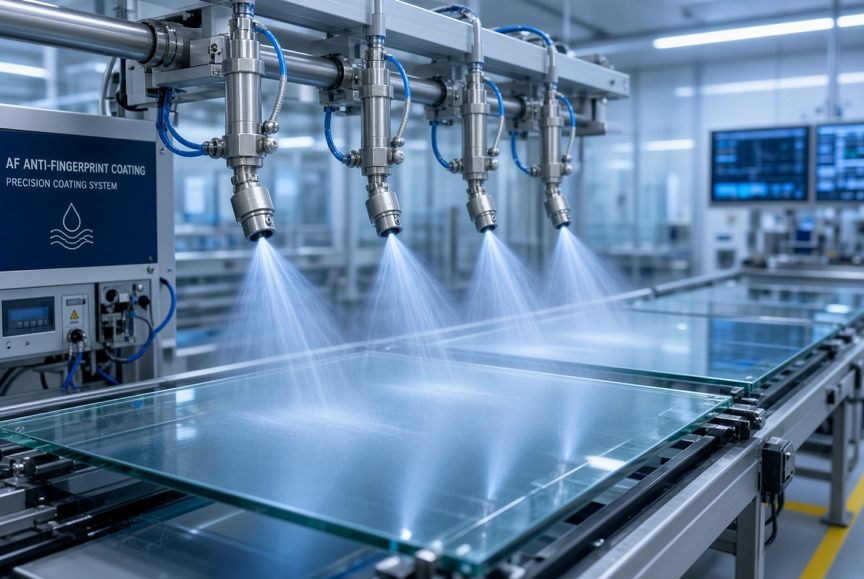
AF spray-coating process where surface preparation, spray uniformity and curing all influence final performance.
Abrasion durability is one of the most important practical reasons to control AF film formation. Finger contact, cleaning cloths, erasers, steel wool and environmental contamination gradually wear the easy-clean layer. Insufficient coverage or weak adhesion can cause the contact angle to drop rapidly after wear.
However, abrasion life should never be linked to thickness alone. Plasma pretreatment, surface cleanliness, coating chemistry, curing conditions and the underlayer can be equally important.
Test Item | Why It Matters |
Initial Water Contact Angle | Shows initial hydrophobic behavior before wear. |
Abrasion Medium | Defines the severity of the wear test and must be stated. |
Applied Load | Strongly affects the test result; cycle count is meaningless without load. |
Stroke / Speed | Controls how aggressively the coating is worn. |
Cycle Count | Defines the durability target for the specific test method. |
Post-Abrasion Water Contact Angle | Shows how much AF performance remains after wear. |
Visual / Surface Inspection | Checks for local wear, unevenness, residues or other defects. |
Engineering note: Avoid publishing fixed claims such as '3,000-10,000 cycles' without the full test method. Real results vary with abrasion head, load, speed, coating chemistry, pretreatment and acceptance criterion.
AF coatings are designed to have minimal visual impact when they are correctly formulated and uniformly deposited. For conventional ultrathin AF topcoats, the optical effect is often small, but excessive deposition, poor spray uniformity, residue or an incompatible multilayer stack can introduce haze, color variation or surface defects.
· Evaluate transmittance and haze on the complete glass stack, not on the AF chemistry alone.
· Check optical performance after all AG, AR, AF or hard-coat layers have been completed.
· For high-resolution displays, verify that the AF process does not introduce local haze, streaking or visible coating nonuniformity.
Average thickness can hide local variation. A panel may meet the nominal mean thickness while still having thin areas, thick edges or spray-pattern defects.
For example, if the center of a panel receives one coating level while the edges receive substantially more or less material, the glass may show different contact angles, cleaning feel and abrasion life across the active area.
This is why process control should consider thickness mapping or multi-point contact-angle mapping rather than relying on a single measurement.
Uniformity Issue | Possible Effect |
Center-to-Edge Variation | Can create inconsistent water contact angle or finger glide. |
Spray Overlap | May produce local thickness bands if motion and atomization are not controlled. |
Edge Accumulation | Can create coating buildup or visible nonuniformity. |
Coffee-Ring / Drying Pattern | Can occur in wet processes when solvent flow or curing is poorly controlled. |
Batch-to-Batch Variation | Can change performance even when the average specification looks acceptable. |
AF coating is also selected for tactile performance. A well-formed surface can reduce friction and provide a smoother finger glide. If the coating is uneven, contaminated or poorly cured, the surface may feel inconsistent even when the average water contact angle appears acceptable.
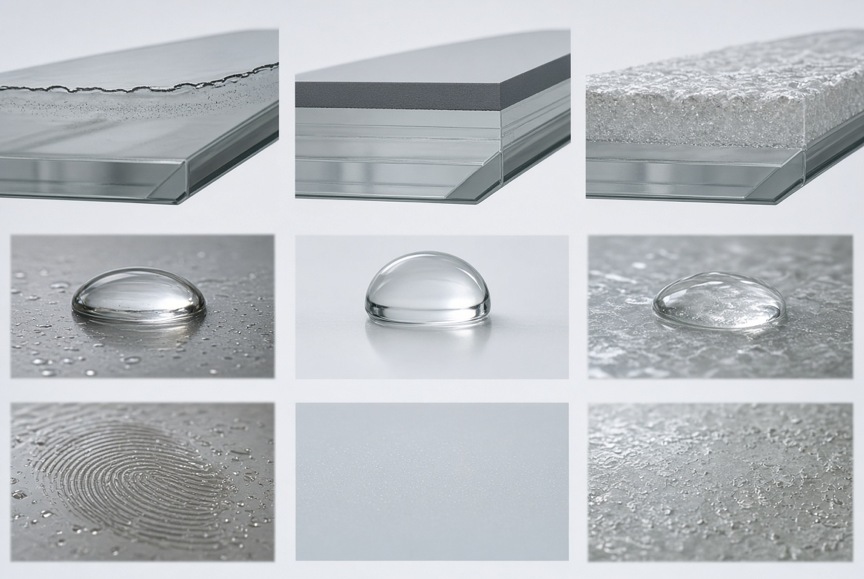
Comparison concept: insufficient, well-formed and poorly controlled surface layers can produce different wetting and fingerprint behavior.
In spray coating, film formation depends on the entire process window rather than one machine setting. Important variables include solution formulation, solids concentration, atomization, nozzle condition, spray distance, path overlap, substrate speed, surface activation and curing.
· AF solution concentration and viscosity
· Nozzle type, atomization pressure and droplet size
· Spray distance and angle
· Glass movement speed and spray overlap
· Number of passes
· Plasma or chemical pretreatment
· Flash-off and solvent evaporation behavior
· Curing temperature and time
· Ambient cleanliness, humidity and contamination control
· Use controlled cleaning and plasma / chemical pretreatment before AF deposition.
· Define a validated spray or deposition window rather than adjusting only by visual appearance.
· Measure contact angle at multiple positions across representative panels.
· Include post-abrasion contact angle in qualification, not only the initial value.
· Check transmittance, haze and appearance when AF is combined with AG, AR or other layers.
· Track lot-to-lot data so thickness, contact angle and durability trends can be correlated over time.
A useful engineering specification should describe measurable performance and test conditions. Simply writing 'AF coating, water contact angle >=115°' leaves too many variables undefined.
Specification Item | Recommended Definition |
AF Process | Spray, vacuum evaporation or other approved process |
Initial Water Contact Angle | Define target and test method |
Oil / Oleophobic Performance | Define test liquid and acceptance criterion if required |
Abrasion Method | Steel wool, eraser or other agreed medium |
Abrasion Load | State the applied load |
Stroke / Speed | Define movement and test geometry |
Cycle Count | State the required durability cycle target |
Post-Abrasion Contact Angle | Define minimum retained performance |
Optical Requirements | Transmittance, haze, reflectance or color where applicable |
Cleaning Compatibility | List alcohol, detergent or disinfectant chemistry if relevant |
Uniformity | Define mapping method or allowed panel-to-panel variation if required |
· Start from the end-use cleaning and abrasion environment.
· Choose the AF process and chemistry according to required durability and cost.
· Define initial and post-abrasion contact-angle targets.
· Confirm coating uniformity across the active area.
· Validate optical performance on the complete cover-glass stack.
· Run pilot samples before locking the mass-production specification.
There is no single universal thickness because AF chemistry and deposition methods differ. Vacuum-deposited functional layers can be extremely thin, while spray, sol-gel or hybrid easy-clean systems may be thicker. Use the coating supplier's validated process window rather than one generic thickness target.
Not always. Water contact angle depends on surface chemistry, molecular coverage, adhesion and film uniformity. Once a continuous low-surface-energy layer is formed, additional thickness may provide little improvement.
Insufficient or nonuniform coverage can lead to lower or unstable water contact angle, easier fingerprint adhesion and faster performance loss after cleaning or abrasion.
Yes. Excessive or poorly controlled deposition can produce diminishing performance returns and may increase the risk of residue, nonuniformity, tactile variation or optical defects depending on the coating system.
A correctly formulated ultrathin AF layer usually has limited optical impact, but excessive deposition, poor uniformity or an incompatible multilayer stack can increase haze or visible defects. The finished glass should be tested as a complete optical stack.
The measurement method depends on film type and thickness. Production control can also use correlated process parameters, surface-analysis methods and multi-point contact-angle mapping. The measurement method should be agreed for the actual coating system.
Many high-performance projects use initial water contact angles above 110 degrees as a reference, but the more meaningful specification also defines how much performance remains after the agreed abrasion test.
Because initial hydrophobicity does not prove long-term durability. Post-abrasion contact angle shows whether the coating still retains useful easy-clean performance after controlled wear.
Spray systems are often thicker than ultrathin vacuum-deposited functional topcoats, but the actual result depends on chemistry and process. Different coating systems should not be compared by thickness alone.
Define the AF process, initial water contact angle, abrasion medium, load, stroke, cycle count, post-abrasion contact angle, optical requirements, cleaning compatibility and any uniformity requirement.

Copyright © 2026 Fuxin Glass (Dongguan City) Technology Co., Ltd. All Rights Reserved