



 2026-09-01
 157
157 Anti-fingerprint (AF) coating is widely used on touchscreen cover glass to reduce fingerprint visibility, improve cleanability and create a smoother touch surface. For OEM projects, however, the coating material alone does not determine performance. Surface preparation, deposition method, curing, film uniformity and durability testing all influence the finished glass.
Two mainstream AF coating routes are commonly used for cover glass: vacuum evaporation and wet spray coating with surface activation such as plasma pretreatment. Both can produce a hydrophobic and oleophobic surface, but they differ in equipment investment, throughput, film uniformity, abrasion durability and suitability for complex coating stacks.
AF coating creates a low-surface-energy film (often reducing surface energy from ~72 mN/m on bare glass to 15–20 mN/m). Water contact angles typically reach ≥110° (premium targets ≥115°), and oleic acid contact angles exceed 70°. The result mimics the lotus-leaf effect: liquids bead up and roll off or wipe clean with minimal residue.
Key benefits for smart-device cover glass include:
l Reduced fingerprint visibility and easier cleaning
l Smooth tactile response (lower friction)
l Minimal impact on light transmittance (usually <0.5% loss)
l Compatibility with AR (anti-reflective) or AG (anti-glare) stacks
The coating is ultra-thin (commonly 5–50 nm, sometimes up to 200 nm depending on process) and bonds chemically via silane groups to the glass surface (Si–O–Si linkages).
Industry practice centers on two primary methods: vacuum evaporation (PVD-based) and spraying (wet process with plasma pretreatment). Both can achieve initial water contact angles ≥110°, but they differ sharply in durability, cost, throughput, and suitability.
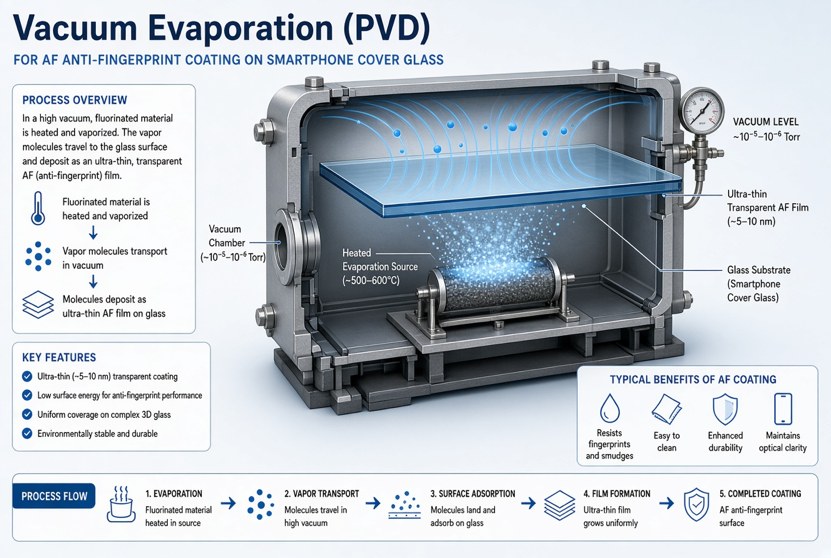
This process deposits the AF material under high vacuum.
Typical steps:
l Thorough cleaning of the cover glass (ultrasonic / alkaline / plasma)
l Loading into a vacuum chamber
l Optional SiO₂ transition/interlayer deposition for better adhesion
l Electron-beam or thermal evaporation of AF pellets (fluorinated material), which vaporize and condense as a dense, uniform film
l Controlled cooling, static settling (often >2 hours), inspection, and packaging
Advantages: Superior film density and adhesion, excellent abrasion resistance, high uniformity, and strong performance when combined with AR coatings. Preferred for high-end smartphones, medical displays, and applications requiring long-term durability (often 3,000–5,000+ steel-wool cycles while retaining WCA >100°).
Limitations: Higher equipment cost, batch processing (typically 30–40 minutes per furnace load), lower throughput (~500 pieces/hour in many systems).
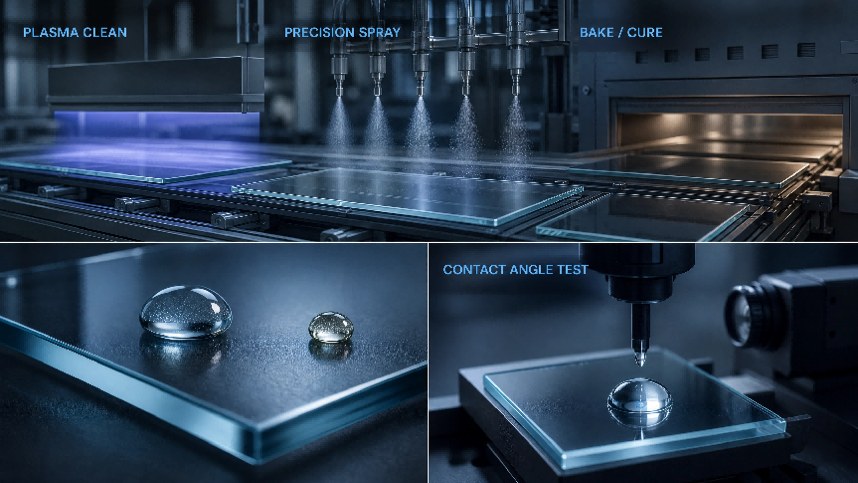
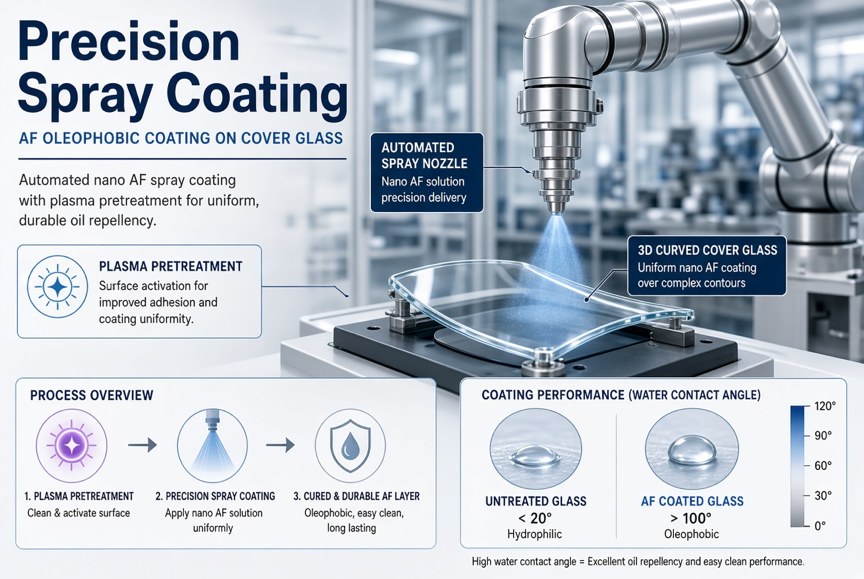
A liquid AF solution is applied after surface activation.
Typical steps:
l Cleaning and plasma pretreatment (oxygen or similar plasma raises surface energy and creates silanol groups for better bonding)
l Atomized spray (or sometimes dip) of diluted fluorosilane solution for uniform wet film
l Thermal curing (commonly 120–150 °C for 30–60 minutes)
l Final cleaning and inspection
Advantages: Lower capital cost, continuous or high-speed production (up to ~2,000 pieces/hour), flexible for larger or irregularly shaped glass. Suitable for mid-to-high volume consumer electronics where cost and capacity matter most.
Limitations: Slightly lower long-term abrasion resistance compared with optimized PVD; performance depends heavily on plasma quality, spray uniformity, and curing control.
Dip Coating: After cleaning, the material is immersed in AF solution while still hot, followed by baking. This method is lower in cost, but the uniformity and mass production efficiency are not as good as spraying/evaporation coating. It is more often used for improvements or specific applications.
Magnetron Sputtering Assist: Primarily used for AR layer deposition. AF itself is rarely directly sputtered, but it can be combined with other methods.
Combined Processes: In actual mass production, AG (anti-glare) and AR (anti-reflective coating) are often layered, such as AG+AF, AR+AF, or AG+AR+AF. AF is usually the outermost layer.
Spraying (Wet) | Vacuum Evaporation (PVD) | |
Equipment cost | Lower | Higher |
Throughput | High (continuous, ~2,000 pcs/h) | Lower (batch, ~500 pcs/h) |
Cycle time | Fast continuous | 30–40 min/furnace |
Initial WCA | ≥110° | ≥110° (can reach higher) |
Abrasion resistance | Good (typically 500–2,000+ cycles) | Excellent (3,000–5,000+ cycles common) |
Best for | Mid-to-high volume, cost-sensitive | Premium durability, AR+AF stacks |
Overall cost | Lower | Medium-to-higher |
Reliable AF performance is verified by:
l Water contact angle (WCA): Initial ≥110° (premium ≥115°); post-abrasion still >100°.
l Abrasion resistance: Steel-wool (#0000) or eraser tests under controlled load (often 500–1,000 g), stroke, and cycle count (2,000–5,000 cycles typical targets). No peeling and retained hydrophobicity required.
l Adhesion: Cross-hatch / tape tests.
l Opticals: Transmittance, haze, reflectance impact.
l Additional: Chemical resistance, friction coefficient, and environmental aging.
These metrics ensure the coating survives daily wiping, pocket abrasion, and real-world use (consumer-grade lifespan often 6–12+ months of heavy use; industrial/PVD grades last longer).
Select based on end-product requirements:
l High-end flagship phones or devices needing years of clean performance + AR → prioritize vacuum evaporation.
l High-volume mid-range devices or cost-optimized lines → spraying with robust plasma pretreatment often delivers the best balance.
l Hybrid needs (e.g., AR + AF) frequently combine vacuum deposition of the optical stack with a top AF layer in the same or sequential chamber.
l Cover-glass material, size and thickness
l Existing surface stack: bare glass, AG, AR or other coating
l Target water contact angle and post-abrasion contact angle
l Abrasion test method, load and required cycle count
l Optical requirements: transmittance, haze, reflectance and color if applicable
l Expected cleaning chemicals and environmental exposure
l Annual volume and target cost range
l Whether vacuum evaporation, spraying or an open process recommendation is preferred
Vacuum evaporation is often preferred when coating uniformity and long-term abrasion durability are the highest priorities. Spray coating can provide a better cost and throughput balance for high-volume projects. The correct choice depends on the product specification rather than one process being universally better.
Many high-performance AF specifications use an initial water contact angle above 110° as a target. However, post-abrasion contact angle and cleanability are more useful for judging long-term coating performance.
Plasma treatment removes residual organic contamination and activates the glass surface so the AF chemistry can bond more consistently during curing. Plasma parameters should be validated together with the coating and durability tests.
Yes. AF is commonly used as the outermost easy-clean layer over compatible AR stacks. The complete stack should be checked for adhesion, reflectance, color and abrasion durability.
Yes. AG + AF is widely used when a display needs both glare reduction and easier cleaning. Because AG surfaces are textured, the coating process must be optimized for wetting, bonding and tactile performance.
Durability is commonly evaluated with controlled abrasion tests followed by water-contact-angle, appearance and cleanability measurements. The abrasion medium, load, stroke and cycle count should always be stated.
Automated spray coating is often attractive for high-volume, cost-sensitive production because it can provide high throughput and flexible handling. Premium products with demanding durability or AR + AF stacks may justify vacuum evaporation.

Copyright © 2026 Fuxin Glass (Dongguan City) Technology Co., Ltd. All Rights Reserved