


 2026-08-11
 215
215 With the continuous development of touchscreen devices, display manufacturers require cover glass with higher strength, thinner thickness and better impact resistance.Chemical strengthened aluminosilicate glass has become an important material solution for high-performance cover glass applications.
Fuxin Glass provides customized chemically strengthened glass solutions for touchscreen displays,industrial panels, automotive displays and other applications requiring high mechanical performance.
The performance of chemically strengthened aluminosilicate glass is mainly evaluated by key parameters including surface compressive stress (CS),depth of layer (DOL) and central tension (CT). These technical indicators determine the strength, durability and reliability of cover glass.
Compared with traditional soda lime glass, aluminosilicate glass provides better strengthening performance through ion exchange technology.
During chemical strengthening, smaller sodium ions in the glass surface are replaced by larger potassium ions. This process creates a compressive stress layer on the glass surface, improving resistance against scratches, bending and impact.
This makes chemically strengthened aluminosilicate glass suitable for applications where thin design and high durability are both required, including smartphone cover glass, industrial touchscreen panels, medical displays and automotive interfaces.
Parameter | Typical Conventional Range | Production Specs | Notes |
Surface Compressive Stress (CS) | 650–1000 MPa (up to 1200 MPa) | ≥700–800 MPa (most requirements ≥700–750 MPa) | For ~0.7 mm thin glass, commonly 650–900 MPa; optimized or two-step processes can stably reach 800–1000+ MPa |
Depth of Layer (DOL) | 25–50 μm (up to 30–100+ μm) | ≥35–40 μm (most requirements ≥37–40 μm) | Conventional K⁺ exchange typically 25–50 μm; Li-containing glasses or two-step/multi-step ion exchange can achieve deeper layers (50–150 μm or more) |
Central Tension (CT) | Typically controlled below 40–70 MPa | Adjusted according to thickness to avoid spontaneous breakage | Approximate formula: CT ≈ CS × DOL / (t − 2×DOL), where t is thickness |
l Bending / Flexural Strength: Significantly enhanced,often reaching several hundred MPa or higher (substantial improvement over the annealed base glass).
l Vickers Hardness: Typically increases to 600–800 HV or higher after strengthening.
l Drop / Impact Resistance: Greatly improved (impact resistance can increase by roughly 10–15 times compared with the original glass),which is a core advantage for cover glass applications.
l Applicable Thickness: Especially suitable for ultra-thin glass in the 0.3–2.0 mm range (or even thinner); thicker sheets are also possible,but the advantages are most pronounced in thin sheets.
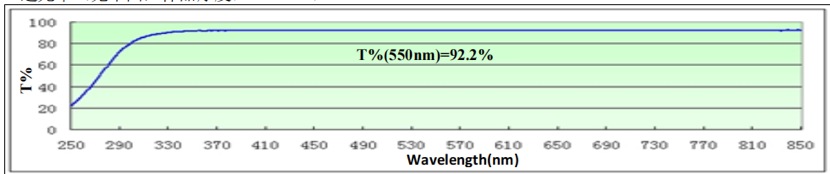
l Optical and Other Properties: High light transmittance with minimal optical distortion; compatible with subsequent processes such as coating and thinning.
Central tension (CT) represents the tensile stress inside the glass after the ion exchange process.
Although surface compression improves glass strength,excessive internal tensile stress may reduce safety and reliability. Therefore, CT must be carefully controlled during the chemical strengthening process.
Professional glass manufacturers evaluate CS,DOL and CT together to ensure the strengthened glass meets the requirements of different cover glass applications.
The following parameters represent typical performance ranges of chemically strengthened aluminosilicate glass used for high-performance cover glass applications.
refractive index: 1.51
photoelastic coefficient 27.2nm/cm/MPa
Transmittance (sample thickness: 0.55 mm)
Temperature | 4h | 5h | 6h | |||
CS(MPa) | DOL(μ m) | CS(MPa) | DOL(μ m) | CS(MPa) | DOL(μ m) | |
400 | 840 | 32 | 830 | 37 | 820 | 41 |
405 | 833 | 35 | 823 | 40 | 813 | 43 |
410 | 826 | 38 | 816 | 42 | 806 | 46 |
415 | 818 | 40 | 808 | 45 | 798 | 49 |
420 | 806 | 42 | 800 | 47 | 788 | 53 |
Remarks | The enhancement conditions can be selected as needed. (Above Na⁺ concentration: 1000–1500 PPM) | |||||
Thickness | CS(MPa) | DOL(μ m) | CT(MPa) | Remarks |
0.40T | ≥700 | ≥30 | ≤105 | Camera cover plate specifications: CS ≥ 700 MPa; DOL: 24 ±5 μm |
0.45T | ≥30 | ≤103 | ||
0.50T | ≥35 | ≤88 | ||
0.55T | ≥750 | ≥35 | ≤82 | |
0.60T | ≥35 | ≤75 | ||
0.65T | ≥35 | ≤72 | ||
0.70T | ≥35 | ≤67 | ||
0.75T | ≥35 | ≤65 | ||
0.80T | ≥37 | ≤61 | ||
0.90T | ≥40 | ≤55 | ||
0.95T | ≥40 | ≤53 | ||
1.00T | ≥40 | ≤51 | ||
1.10T | ≥40 | ≤49 | ||
1.20T | ≥40 | ≤47 | ||
1.30T | ≥40 | ≤44 | ||
1.40T | ≥40 | ≤42 | ||
1.50T | ≥40 | ≤40 | ||
1.60T | ≥40 | ≤39 | ||
1.80T | ≥40 | ≤37 | ||
2.00T | ≥40 | ≤35 |
l Salt Bath: Primarily KNO₃ (high purity required); NaNO₃ or other additives may be included. Two-step processes are common (deeper exchange first, followed by high surface stress exchange).
l Temperature: Approximately 390–450 °C (commonly 400–430 °C).
l Time: Several hours to more than ten hours (single-step typically 2–8 h; deeper DOL requires longer times or specialized processes).
l Influencing Factors: Glass composition (Al₂O₃, alkali metals, P₂O₅, Li₂O, etc.), salt bath purity and impurities (especially Na⁺), temperature/time control, and original glass surface condition.
l High-alumina silicate glass achieves significantly higher CS (typically 650+ MPa vs. 100–500/650 MPa for soda-lime) and deeper DOL (25–50 μm vs. 5–20 μm).
l Performance advantages are clear, but production cost is higher and melting is more difficult.
Due to its high strength, thin design capability and excellent durability,chemically strengthened aluminosilicate glass is widely used in advanced display applications.
Touchscreen products require cover glass that can withstand repeated operation,impact and daily wear.Chemically strengthened aluminosilicate glass provides reliable protection while maintaining a slim product design.
Industrial control panels often operate in demanding environments.High-strength chemically strengthened glass improves durability and long-term reliability for HMI applications.
Automotive touchscreen displays require excellent mechanical strength and optical quality.Aluminosilicate cover glass helps meet durability requirements for vehicle display systems.
Medical devices require durable and reliable display protection.Chemical strengthened glass provides improved resistance against scratches and accidental impact.
l Smartphones and tablet cover glass
l Industrial touchscreen equipment
l Automotive infotainment displays
l Medical control panels
l Smart home touch displays
Fuxin Glass provides customized chemically strengthened glass solutions for global OEM customers requiring reliable cover glass performance.
Our manufacturing capability includes glass cutting, chemical strengthening, surface coating and customized processing for different display applications.
l Customized glass thickness and size
l Chemical ion exchange strengthening
l CNC machining and edge processing
l Silk screen printing
By combining material technology with customized processing capability, Fuxin Glass helps customers develop high-performance cover glass products for different industries.
Chemically strengthened aluminosilicate glass is a high-performance glass material strengthened through ion exchange technology. It provides higher surface compressive stress and deeper stress layers compared with conventional glass materials.
The main technical parameters include surface compressive stress (CS), depth of layer (DOL) and central tension (CT). These values determine the mechanical strength and reliability of strengthened cover glass.
CS (surface compressive stress) refers to the compression force generated on the glass surface after ion exchange strengthening. Higher CS generally improves resistance against scratches and impact.
DOL (depth of layer) represents the depth of the strengthened compression layer beneath the glass surface. A deeper DOL improves the ability of glass to resist damage penetration.
Aluminosilicate glass provides excellent strengthening performance, thin design capability and durability, making it suitable for touchscreen displays, automotive displays, industrial panels and medical equipment.
Yes. Fuxin Glass provides customized chemically strengthened glass solutions including thickness, size, strengthening process, coating and additional processing according to customer requirements.
Chemical strengthened aluminosilicate glass has become an important material solution for modern cover glass applications due to its high strength, thin structure and excellent durability.Understanding key parameters such as surface compressive stress (CS), depth of layer (DOL) and central tension (CT) helps engineers select the right glass solution for different display applications.
Fuxin Glass continues to provide customized chemically strengthened aluminosilicate glass solutions for touchscreen displays, industrial equipment, automotive systems and other high-performance applications.

Copyright © 2026 Fuxin Glass (Dongguan City) Technology Co., Ltd. All Rights Reserved