



FUXIN manufactures custom AF anti-fingerprint cover glass for smart home control panels, wall switches, thermostats, home automation hubs and other frequently touched residential interfaces. The oleophobic AF surface reduces visible fingerprints and skin oils, improves cleanability and provides a smoother finger-glide experience while maintaining the optical clarity required for touch displays.
Glass size, shape, thickness, cutouts, edge profiles, strengthening and silk-screen printing can be customized to match compact smart-home devices. Typical project thicknesses may include 0.5, 0.7, 1.0, 1.1, 1.5 and 2.0 mm, subject to material, size, strengthening and mechanical requirements.
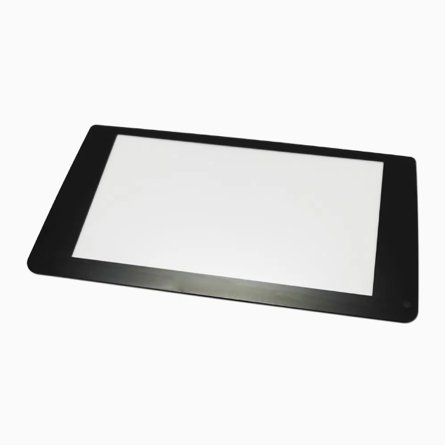
Custom printed AF cover glass for smart home control panels and compact touch interfaces.
Frequent Daily Touch: Smart switches, wall panels and thermostats are touched many times each day, so skin oils and smudges quickly become visible on untreated glossy glass.
Easy Cleaning: A low-surface-energy AF layer reduces oil adhesion and helps fingerprints wipe away more easily with an appropriate cleaning cloth.
Cleaner Premium Appearance: Frequently touched smart-home devices are often installed in visible living spaces, where a clean front surface contributes directly to perceived product quality.
Smooth Finger Glide: A properly formed oleophobic surface can reduce friction and improve gesture control on capacitive touch interfaces.
Optical Compatibility: AF is designed to add easy-clean functionality with minimal visual impact when the coating system is correctly selected and applied.
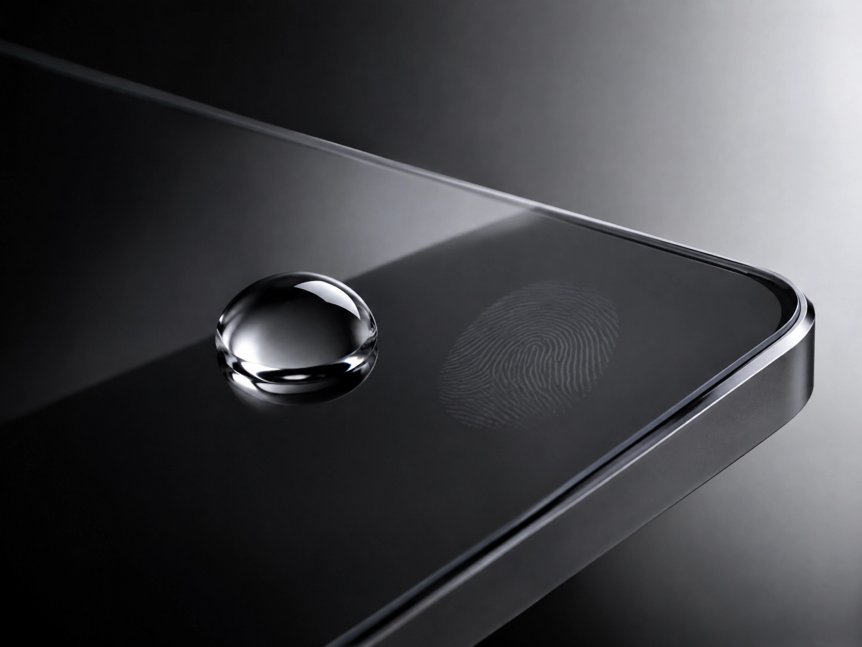
Oleophobic AF surface behavior showing reduced fingerprint and oil adhesion.
Smart Home Wall Control Panels: Central interfaces for lighting, HVAC, curtains, security and whole-home automation.
Smart Switches & Scene Controllers: Compact high-touch panels where fingerprints are especially visible on black or glossy front glass.
Thermostats & Climate Controllers: Wall-mounted controls that require clean appearance, smooth touch and custom printed windows.
Smart Appliance Interfaces: Refrigerators, ovens, coffee machines and washing-machine interfaces using decorative touch glass.
Home Security & Access Panels: Indoor security hubs, video-doorbell interfaces and residential access-control panels.
Multi-Room & IoT Controllers: Touch hubs and connected-device interfaces used frequently by multiple household members.
AF and AG solve different problems. AF is primarily an easy-clean and anti-smudge surface treatment, while AG reduces visible glare by diffusing reflected light. A smart-home device may need one or both functions depending on its location and display design.
Item | AF Anti-Fingerprint | AG Anti-Glare |
Main Purpose | Reduce fingerprints, oils and smudges | Reduce glare and disturbing reflections |
Surface Appearance | Usually clear / glossy depending on base glass | Matte or satin appearance |
Best Use | High-touch indoor interfaces | Bright rooms, window-facing or strong ceiling-light locations |
Touch Benefit | Smoother finger glide and easier cleaning | Texture must be balanced with finger/stylus feel |
Combination | Can be combined with compatible AG or AR stacks | AG + AF can provide glare control plus easier cleaning |
Water contact angle is a useful AF indicator, but it should not be the only acceptance criterion. For smart-home devices, the more practical question is whether the surface remains easy to clean after repeated touching, wiping and household use.
Parameter | How to Define It |
Initial Water Contact Angle | Project-specific; high-performance AF systems commonly use an agreed target above 110° under the defined test method. |
Post-Abrasion Contact Angle | Shows whether hydrophobic performance is retained after wear. |
Oil / Fingerprint Resistance | Define the expected easy-clean behavior or an agreed oleophobic test. |
Coefficient of Friction / Touch Feel | Useful when smooth finger glide is an important UI requirement. |
Cleaning Compatibility | Validate against the cleaning cloths, alcohols, detergents or household cleaners expected in service. |
Optical Performance | Confirm transmittance, haze and visible appearance on the complete cover-glass stack. |
Compact smart-home devices often use relatively thin cover glass to support a slim product profile and responsive capacitive touch. FUXIN can evaluate thicknesses from approximately 0.5 to 2.0 mm for suitable projects, but the final selection should be based on glass size, substrate, strengthening, hole / cutout geometry, mounting structure and impact requirements.
Thickness Direction | Typical Selection Logic |
0.5-0.7 mm | Very thin compact interfaces where low weight and touch sensitivity are priorities; mechanical feasibility must be reviewed. |
1.0-1.1 mm | Common starting point for many compact control panels and touch interfaces. |
1.5-2.0 mm | Considered when higher rigidity or mechanical margin is needed while retaining a relatively slim front panel. |
Smart-home interfaces are rarely limited to a standard rectangular cover lens. The glass can be processed to match the enclosure and industrial design of the final device.
l Rectangular, square, round-corner and irregular outlines
l Custom CNC holes, notches, slots and sensor windows
l Polished, chamfered, beveled and custom edge profiles
l Black bezel, white / custom-color printing, icons and logos
l Transparent windows for ambient-light sensors, proximity sensors, LEDs or cameras
l Chemical strengthening or thermal tempering where suitable
l Optional AG, AR or combined surface functions where project-compatible
Item | Specification / Capability |
Glass Material | Soda-lime or aluminosilicate cover glass; other compatible substrates subject to review |
Thickness | Approx. 0.5-2.0 mm for suitable smart-home projects; custom by engineering review |
AF Surface | Oleophobic / anti-fingerprint coating |
Water Contact Angle | Project-specific; high-performance AF may target initial values above 110° under agreed test conditions |
Size & Shape | Fully custom to drawing or approved sample |
Strengthening | Chemical strengthening or thermal tempering according to material and thickness |
Edge Processing | Polished, ground, chamfered, beveled or custom |
Printing | Black bezel, logos, icons, masking areas and functional windows |
Optional Surface Functions | AG anti-glare, AR anti-reflective or compatible combinations |
Bonding / Mounting | Frame bonding, pre-applied adhesive or optical-bonding preparation according to device architecture |
Engineering note: The source draft includes fixed values such as >91-96% transmittance and a typical water contact angle >=110°. These should be treated as project-specific results tied to glass substrate, AF chemistry and test method rather than universal guarantees for every configuration.
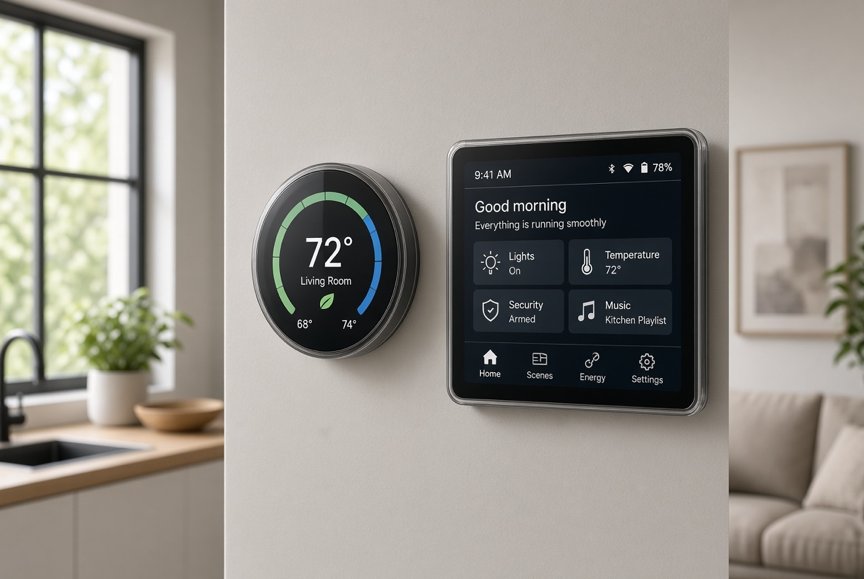
Smart-home wall control and thermostat interfaces are high-touch applications where AF easy-clean performance is valuable.
Information | What to Provide |
Device Type | Smart wall panel, switch, thermostat, appliance display, security hub or other interface |
Glass Drawing | Overall size, viewing area, holes, cutouts, corner radius and tolerance |
Thickness | Preferred thickness or mechanical target |
Glass Material | Preferred substrate if already specified |
AF Requirement | Initial WCA, post-abrasion requirement, easy-clean target or reference sample |
Cleaning Environment | Expected cloth, alcohol, detergent or household-cleaner exposure |
Printing | Black border, logo, icons, transparent windows and color requirements |
Additional Surface Function | AG, AR or combined treatment if required |
Mounting / Bonding | Frame bonding, pre-applied adhesive, OCA optical bonding or other assembly method |
Quantity | Prototype quantity and expected annual volume |
A strengthened cover glass with AF anti-fingerprint / oleophobic treatment is a strong option when the main concern is fingerprints, oily smudges and easy daily cleaning. The final glass should also match the device's thickness, printing, mounting and touch requirements.
Yes. AF cover glass is especially useful on smart switches and wall control panels because these surfaces are touched frequently and are often installed in highly visible areas of the home.
The correct thickness depends on glass size, material, strengthening, mounting structure and impact requirement. For compact devices, approximately 0.5-2.0 mm may be evaluated, with 1.0-1.1 mm often serving as a practical starting point.
The AF layer itself is extremely thin and is generally compatible with capacitive touch when the total cover-glass thickness and touch stack are correctly designed.
Many high-performance AF projects use an initial water contact angle above 110 degrees as a reference, but long-term quality should also be evaluated after an agreed abrasion or cleaning test.
Yes. FUXIN supports custom CNC shapes, holes, sensor windows, black bezels, logos, icons and other decorative or functional printing according to the customer drawing.
Choose AF when fingerprint resistance and easy cleaning are the main priorities. Choose AG when glare from windows or ceiling lights is the primary problem. Compatible AG + AF solutions can be evaluated when both functions are required.
Yes. AF can be used with compatible AR structures when the coating sequence and optical requirements are validated for the project.
Yes. Depending on the device architecture, the cover glass can be prepared for frame mounting, pre-applied adhesive or OCA optical bonding.
Please provide the device type, 2D drawing, glass thickness, AF performance target, cleaning environment, printing artwork, optional AG/AR requirement, mounting or bonding method and expected production volume.

Copyright © 2026 Fuxin Glass (Dongguan City) Technology Co., Ltd. All Rights Reserved