



 2026-07-14
 150
150 In the rapidly evolving world of optical glass solutions, Anti-Glare (AG) glass plays a critical role in enhancing visibility, reducing eye strain, and improving user experience across digital displays, touchscreens, medical devices, industrial panels, and architectural applications. Two primary manufacturing methods-chemical etching and spray coating-dominate the market. Understanding their common microscopic features and key differences helps engineers, manufacturers, and buyers select the optimal solution for high-performance needs.
AG glass works by scattering specular (mirror-like) reflections into diffuse light through surface modification. Under a microscope or scanning electron microscope (SEM), these surfaces reveal distinct microstructures that control light behavior, haze, gloss, and durability.Etched AG Glass (Chemical Etching):
l Produced via controlled acid etching (typically HF-based solutions) through immersion or spray, creating permanent microscopic textures directly into the glass substrate.
l Common microscopic features: Uniform micro-roughness with pits, peaks, and valleys. Etch depth often ranges from 0.05–0.07 mm, with controlled Ra (roughness average) values typically between 0.08–2.0+ μm. The surface shows a homogeneous, frosted microstructure of interconnected craters or granular patterns at the nanoscale to microscale.
l Results in excellent light diffusion, low haze options, high optical clarity, and inherent durability since the texture is integral to the glass (not a coating).
l Involves spraying fine particles (e.g., sub-micron silicon dioxide or similar) onto the glass surface, followed by heating/curing to form an adherent layer.
l Common microscopic features: A deposited particulate layer forming irregular or semi-uniform micro-protrusions and agglomerates. The microstructure appears as a textured overlay of bonded spheres or clusters, creating surface roughness for diffusion but with potential for less uniformity compared to etching.
l Offers good glare reduction but may show variations in particle density and adhesion under microscopic examination.
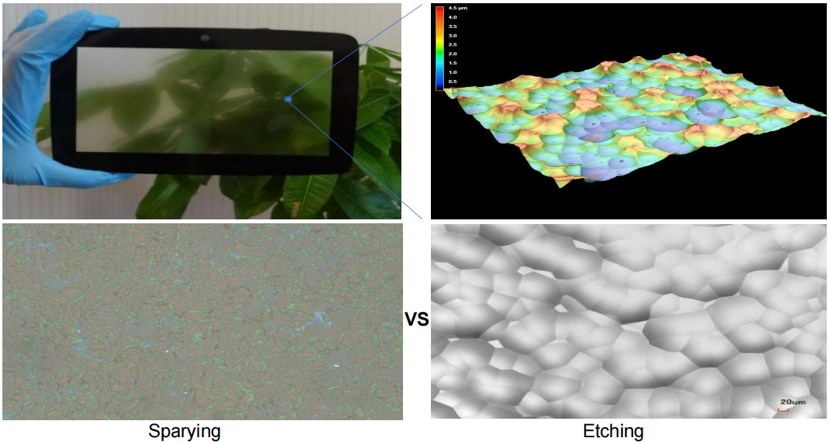
Etched AG Glass | Sprayed AG Glass | |
Surface Structure | Integrated micro-pits/valleys in glass | Deposited particle layer |
Uniformity | Highly uniform (chemical process) | Good but can vary with application |
Durability | Superior (scratch/corrosion resistant) | Moderate(coating adhesion dependent) |
Haze & Gloss Control | Excellent range, low haze possible | Effective but potentially higher haze |
Microscopic View | Homogeneous etched texture | Particulate clusters |
As demand grows for premium anti-glare solutions, partnering with experienced manufacturers ensures precise control over microscopic parameters like roughness, haze, and transmittance. For inquiries about high-quality AG etched glass, sprayed AG glass, or custom microscopic surface engineering, contact our team right now.
Chemically etched AG glass has longer service life. Its anti-glare texture is integrated with the glass substrate, which is scratch-resistant and corrosion-resistant and will never peel off; sprayed AG is an additional coating, which may wear off after long-term friction and cleaning.
Etched AG glass has better uniformity. The chemical reaction process forms a homogeneous texture on the whole surface, while sprayed AG may have slight differences in particle density locally.
Yes. As long as the surface roughness (Ra) is precisely controlled, both processes can be compatible with capacitive and infrared touch systems without affecting touch accuracy.
Chemically etched AG glass supports a wider haze adjustment range, and can achieve low haze and high clarity formula while maintaining anti-glare effect, which is more suitable for high-precision display scenarios.

Copyright © 2026 Fuxin Glass (Dongguan City) Technology Co., Ltd. All Rights Reserved