



 2026-06-23
 29
29 If you are confused about choosing AG or AR functional glass for touch screens, medical monitors, solar panels or outdoor kiosks, this detailed guide clarifies their core working mechanisms, optical parameters, visual performance, costs and suitable scenarios to help you make the right customization choice.
AG (Anti-Glare) glass, also known as anti-glare or non-glare glass, features a specially treated surface—typically through chemical etching or spraying—that creates a microscopic roughness. This diffuses incoming light rays in multiple directions rather than allowing specular (mirror-like) reflections.
l Matte or frosted appearance
l Reduces harsh glare and eye strain in bright or outdoor environments
l Moderate reflection reduction (typically diffuses 6-8% or more)
l Slightly lower light transmission (around 85-92%)
l Can introduce minor haze, trading some image sharpness for comfort
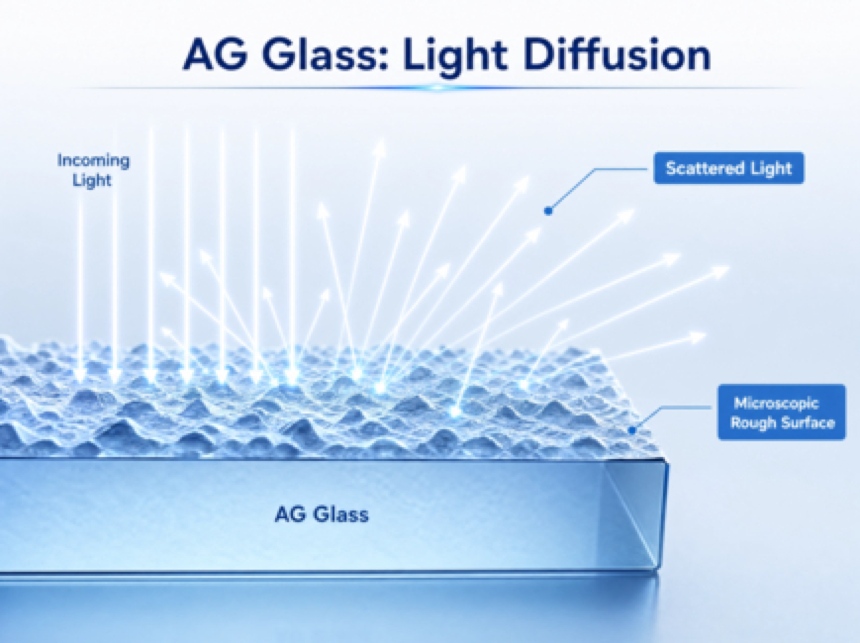
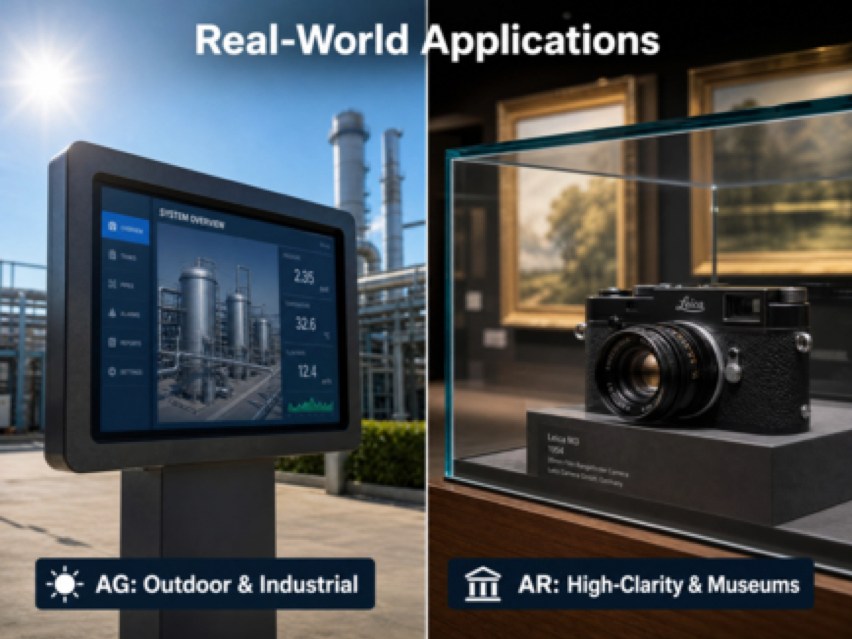
AG glass excels in high-ambient-light settings like public kiosks, outdoor digital signage, industrial displays, and touchscreens where direct sunlight or overhead lighting causes uncomfortable reflections.
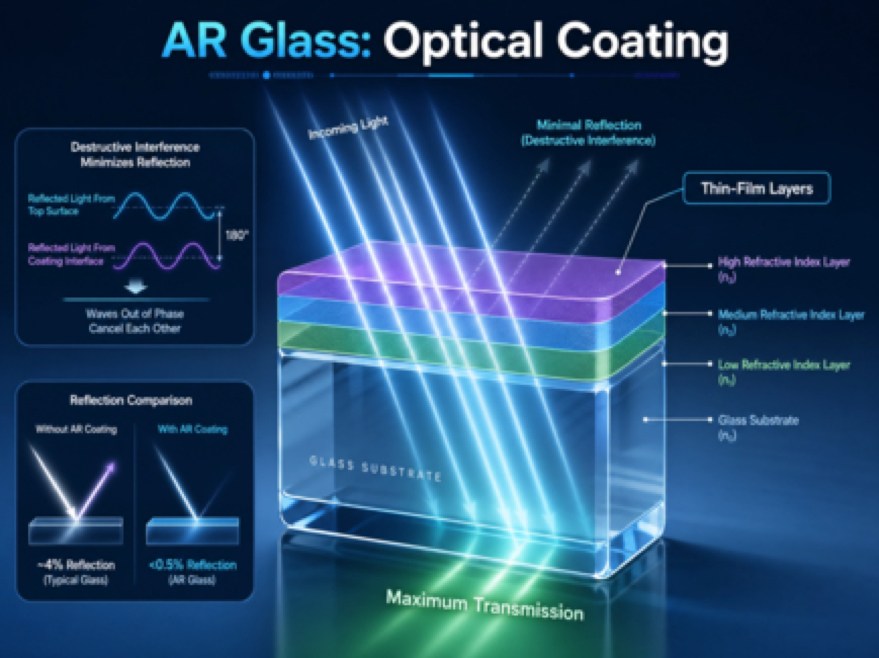
AR (Anti-Reflective) glass uses precision optical thin-film coatings (often vacuum deposition or sputtering) applied to one or both sides of the glass. These layers create destructive interference that cancels out reflected light waves, allowing more light to pass through.
l Crystal-clear, glossy appearance with minimal visible coating
l Dramatically reduces reflections (often to <0.5-1% per side)
l High light transmission (up to 95-99.5% or more)
l Maintains excellent image clarity, contrast, and color accuracy
l More effective at eliminating both external and internal reflections
AR glass is ideal for applications demanding maximum transparency, such as museum displays, high-end retail signage, camera lenses, solar panels, automotive displays, and indoor high-resolution screens.
AG Coated Glass | AR Coated Glass | |
Working Principle | Light diffusion via surface texture | Thin-film interference |
Surface Look | Matte/Frosted | Clear/Glossy |
Reflection Reduction | Moderate (scatters light) | Excellent(cancels reflections) |
Light Transmission | 85-92% | 95-99.5%+ |
Image Clarity | Slight haze possible | Superior sharpness & contrast |
Best For | Bright/outdoor environments | High-clarity & low-light needs |
Cost | Generally lower | Higher(precision coating) |
Durability | Good (etched versions robust) | Excellent (depends on coating) |
l Choose AG when viewer comfort in variable or bright lighting is priority (e.g., airport kiosks, factory floors, outdoor menus).
l Choose AR for premium visual quality where reflections must be nearly invisible (e.g., art galleries, control rooms, medical displays, photography).
l Hybrid AG/AR offers the best of both for touch-enabled or multi-angle viewing applications.
l Full in-house production lines for AG etching and AR vacuum sputtering coating, one-stop CNC cutting, edge polishing and silkscreen printing service.
l Customizable haze value for AG glass and single/double-sided AR coating to match your optical parameter demands.
l Compatible composite coating support: AF anti-fingerprint + AG / AR hybrid functional glass.
l Complete optical testing equipment to inspect transmittance, reflectance and haze before shipment.
l Accept small sample prototype orders and large-volume bulk export orders for global B2B buyers.
Yes, FUXIN provides AG+AR composite coated glass, which retains anti-glare soft viewing while reaching ultra-high light transmittance.
AR anti-reflective glass owns much higher transmittance (95%~99.5%), while AG glass transmittance ranges from 85% to 92%.
Not recommended. AR glass is better for medical monitors to ensure accurate color and clear image without haze. AG is more fit for outdoor bright environments.
FUXIN manufactures custom AG anti-glare glass, AR anti-reflective glass and AG+AR composite coated glass with full custom size, thickness and edge processing. If you need optical display cover glass for automotive, medical, solar or industrial touch devices, send your optical parameter requirements to get free samples and competitive wholesale quotations. You can also check our AF anti-fingerprint, AM antimicrobial coated glass and CNC glass cutting processing pages for integrated functional glass solutions.

Copyright © 2025 Fuxin Glass (Dongguan City) Technology Co., Ltd. All Rights Reserved