



 2026-05-12
 281
281 Tempered glass is widely used in construction, appliances, display protection, and other safety-critical applications because of its strength and safety performance. Compared with ordinary annealed glass, tempered glass offers much higher impact resistance and breaks into small blunt fragments rather than sharp shards.
However, under certain conditions, tempered glass may still break without any visible external impact. This phenomenon is known as spontaneous breakage. Understanding its causes is important for architects, contractors, glaziers, and property owners who need safe and reliable glass solutions.
To understand spontaneous breakage, it is first necessary to understand how tempered glass is made.
During the tempering process, glass is heated to approximately 600–700°C until it reaches a softened state. It is then rapidly cooled by high-pressure air. This fast cooling creates a compressive stress layer on the surface and a tensile stress layer in the core.
This internal stress structure is what gives tempered glass its strength. In normal conditions, the compressive and tensile forces remain in balance, making tempered glass approximately four to five times stronger than annealed glass. But once that balance is disturbed, the stored internal energy can be released suddenly, causing the entire panel to shatter.
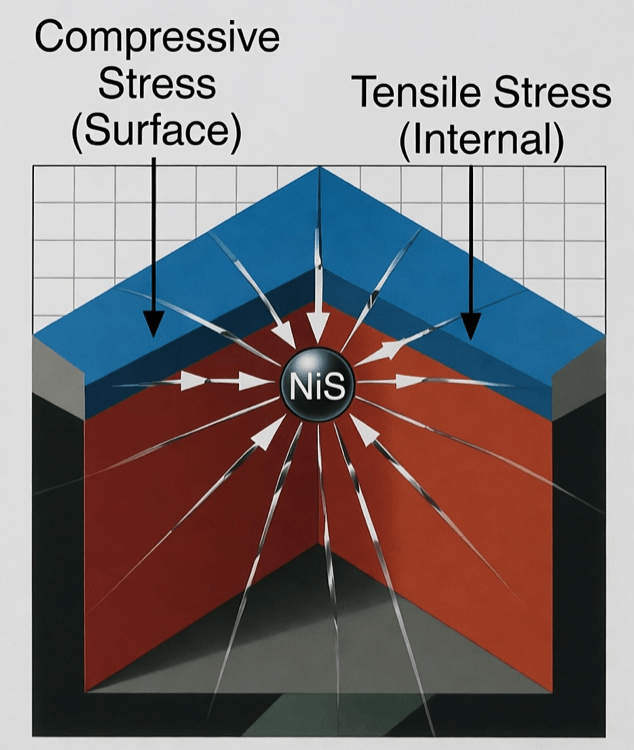
One of the most common causes of spontaneous breakage is nickel sulfide (NiS) inclusions inside the glass.
These tiny particles can enter the glass during raw material melting or from furnace components during manufacturing. At high temperatures, NiS remains in a stable phase. During rapid quenching, this phase can become trapped inside the glass. Over time, it may slowly transform into another phase with a slightly larger volume.
Although the volume change is extremely small, the internal tensile stress inside tempered glass is very high. This expansion can create strong local pressure around the inclusion. Once the stress exceeds the glass’s limit, a crack can begin from the inside and spread rapidly through the panel, causing spontaneous breakage.
In many cases, the fracture origin may show a characteristic butterfly-shaped pattern, which is often associated with NiS-related failure.
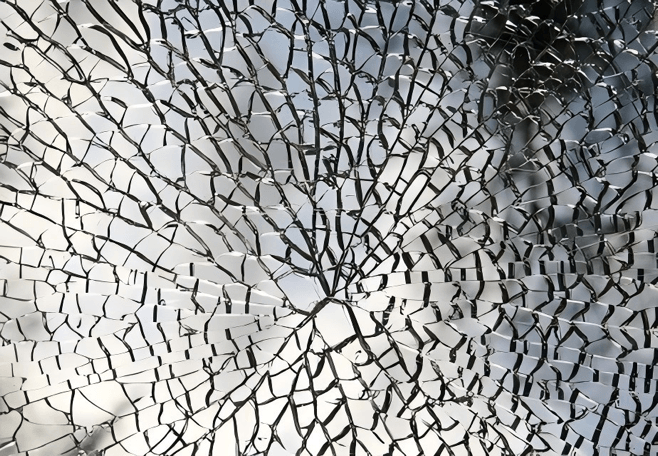
Although NiS inclusions are a major cause, other factors can also increase the risk of spontaneous breakage or make the glass more vulnerable to failure.
If the tempering process is not well controlled, uneven heating or cooling may create local stress concentrations inside the glass.
Small chips, scratches, or poorly finished edges can become crack initiation points, especially during handling, transport, or installation.
Sudden temperature changes, such as strong sunlight followed by cold rain or localized heat exposure, can create thermal stress that challenges the internal balance of the glass.
If the glass is installed without enough expansion clearance, edge compression may occur. This is a common installation mistake that can increase breakage risk.
Bubbles, stones, and other inclusions may also create weak points inside the glass structure.
Although spontaneous breakage cannot always be eliminated completely, the risk can be significantly reduced through proper manufacturing, inspection, and installation practices.
Heat soak testing is one of the most effective methods for reducing the risk of NiS-related breakage. In this process, tempered glass is reheated in a controlled chamber to accelerate the failure of panels containing unstable inclusions before delivery.
Good edge grinding, careful drilling, and proper transport help prevent micro-damage that may later lead to crack formation.
Installers should leave adequate expansion gaps and use proper setting blocks and elastic support materials to avoid unnecessary edge pressure.
Choosing a qualified supplier with strict raw material control, stable tempering processes, and strong furnace maintenance helps reduce the probability of inclusions and internal stress defects.
Spontaneous breakage is relatively rare, but when it occurs, it can lead to safety risks, maintenance costs, project delays, and reputational damage. For projects that require high reliability, understanding the causes of spontaneous breakage makes it easier to choose the right glass specification, request heat soak testing when needed, and ensure proper installation quality.
For architects, OEM buyers, contractors, and project managers, this is not just a technical issue. It is also an important part of long-term safety and product performance.
Fuxin Glass specializes in custom tempered glass and cover glass solutions for a wide range of applications. With strict quality control, precision processing capability, and professional technical support, we help customers reduce risk and improve reliability in real-world use.
If you are looking for high-quality tempered glass, heat-soak tested glass, or customized cover glass solutions, Fuxin Glass is ready to support your project.
Contact us for more information, technical support, or a customized quotation.

Copyright © 2026 Fuxin Glass (Dongguan City) Technology Co., Ltd. All Rights Reserved